Understanding Low-E Glass Coatings
Low-E coatings play an important role in a window’s overall performance and can have a significant impact on a home’s heating, cooling, and lighting costs. But what exactly is Low-E glass, and how does it work?
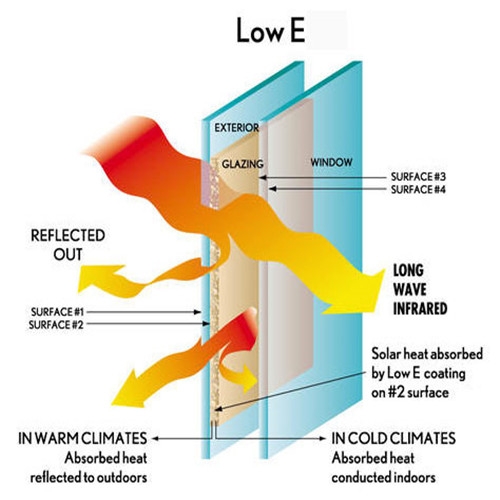
The “E” stands for emissivity — a material’s ability to absorb and radiate thermal energy. Emissivity is measured on a scale of 0.00 to 1.00. Standard clear float glass has an emissivity of approximately 0.84, meaning it readily absorbs and re-radiates heat. A quality Low-E coating reduces this to as low as 0.02–0.04, dramatically limiting how much heat the glass surface absorbs and re-emits.
When solar energy — ultraviolet (UV) light, visible light, and infrared (IR) radiation — strikes a window, it is either transmitted through the glass, absorbed by it, or reflected. In untreated glass, a significant portion of that energy is absorbed and then re-radiated into the building in summer or lost to the outdoors in winter. Low-E coatings interrupt this process.
How the Solar Spectrum Works
To fully understand Low-E glass, it helps to know the three parts of the solar energy spectrum:
- Ultraviolet (UV) light — Wavelengths of approximately 310–380 nanometers. Invisible to the human eye. UV light is the primary cause of fading and deterioration in fabrics, flooring, furnishings, and wall coverings.
- Visible light — Wavelengths of 380–780 nanometers. This is the natural daylight we see and want to preserve inside a building.
- Infrared (IR) light — Wavelengths above 780 nanometers. Also invisible. Infrared is heat energy, and it comes in two forms: short-wave IR arriving directly from the sun, and long-wave IR re-radiated from warm surfaces inside your home (walls, floors, furniture, the glass itself).
Low-E coatings are engineered to selectively filter this spectrum — blocking most UV and infrared energy while allowing the maximum amount of visible light to pass through freely. The result is a brighter, more comfortable interior with significantly less solar heat gain or heat loss depending on the type of coating applied.
What the Coating Is Made Of
A Low-E coating consists of microscopically thin, optically transparent layers of metallic compounds — most commonly silver, zinc oxide, or tin oxide — applied directly to the glass surface. These layers are so thin (often measured in nanometers) that they are completely invisible to the naked eye and do not noticeably change the appearance of the glass. Multiple layers are typically stacked to achieve the desired performance profile.
Modern high-performance coatings use double- or triple-silver layer stacks. Triple-silver Low-E coated glass can transmit nearly 70% of the sun’s available visible light into a building while blocking up to 75% of its infrared and ultraviolet energy — a remarkable combination of daylighting and thermal control that would have been impossible in earlier generations of window glass.
The Two Types of Low-E Coatings
The original page correctly identified two types of Low-E coatings but provided no explanation. This is the most important choice a buyer makes when specifying Low-E glass:
Passive Low-E Coatings Passive Low-E coatings are engineered to maximize solar heat gain, allowing solar short-wave infrared energy to pass through the glass and help heat a building during the winter. This creates passive heating, which reduces reliance on artificial heating systems and lowers energy costs. Millenniumwindows Passive coatings are best suited for colder climates with long heating seasons, where the goal is to capture as much free solar heat as possible while still minimizing heat loss through the glass at night. In a standard double-pane insulating glass unit (IGU), passive Low-E coatings are placed on surface 3 and/or 4 — the surfaces furthest from the sun — so they reflect long-wave infrared heat back into the room.
Solar Control Low-E Coatings Solar control Low-E coatings are designed to limit solar heat gain by reflecting solar short-wave infrared energy. This functionality is crucial for keeping buildings cooler, especially in warmer climates or seasons, thereby reducing the energy consumption associated with air conditioning. Millenniumwindows Solar control coatings are typically applied to surface 2 of the IGU — the inward-facing surface of the outer pane — where they intercept incoming solar radiation early and reflect it back outside before it can enter the building.
Which type do you need? The right choice depends on your climate. Homes in cold northern climates typically benefit most from passive Low-E coatings. Homes in hot southern climates, or those with large south- or west-facing glass exposures, typically benefit most from solar control coatings. Mixed climates may call for a dual-function product. MILLENNIUM® can help you identify the right specification for your project and location.
How Low-E Coatings Are Applied: Hard Coat vs. Soft Coat
Both passive and solar control Low-E coatings can be produced through two manufacturing methods:
Hard Coat (Pyrolytic Process) The coating is applied to the glass ribbon while it is still being produced on the float line at high temperatures. The metallic layer fuses directly to the hot glass surface, creating an extremely durable bond. Hard coat glass can be used in single-pane applications and is relatively easy to handle and fabricate. The trade-off is that hard coat coatings generally have somewhat higher emissivity and offer less solar control performance compared to soft coat.
Soft Coat (Magnetron Sputter Vacuum Deposition — MSVD) The coating is applied to pre-cut glass in a vacuum chamber after the glass has cooled. Metal particles are deposited onto the glass surface in microscopically thin layers. The resulting coating is extremely thin and delicate and must be sealed inside an insulating glass unit to protect it from abrasion and oxidation — it cannot be left exposed. Soft coat Low-E glass delivers superior thermal performance and lower emissivity than hard coat, and is the industry standard for high-performance double and triple-pane IGUs.
Key Performance Metrics
When evaluating any Low-E window, look for NFRC (National Fenestration Rating Council) ratings for these values:
- U-Factor — The rate of heat transfer (heat loss) through the window. Lower is better. Standard clear double-pane glass typically rates around 0.48; a quality Low-E double-pane with argon fill can achieve 0.25–0.30.
- Solar Heat Gain Coefficient (SHGC) — The fraction of solar heat that passes through the window. Lower SHGC = better solar control (ideal for hot climates). Higher SHGC = more passive solar gain (ideal for cold climates).
- Visible Light Transmittance (VT) — The percentage of visible light that passes through. A well-engineered Low-E coating maintains a high VT even while controlling heat.
- Emissivity — The lower the number, the more heat the coating reflects. Quality soft coat Low-E glass achieves emissivity values as low as 0.02.
Benefits of Low-E Glass
Energy Savings — Low-E windows can reduce heating and cooling energy loss through the glazing by 30–50% compared to uncoated glass, depending on climate and coating type. Windows are one of the highest-impact thermal envelope upgrades available.
Interior Comfort — By reducing heat transfer through the glass surface, Low-E windows eliminate cold radiant surfaces in winter and hot glass surfaces in summer, helping maintain consistent, comfortable temperatures throughout the room.
UV Protection — Low-E coatings block a substantial portion of ultraviolet radiation, significantly reducing fading of fabrics, hardwood floors, carpeting, artwork, and furnishings without noticeably reducing natural light levels.
Reduced Condensation — The improved insulating performance of Low-E glass keeps the interior glass surface warmer in winter, reducing condensation and the moisture damage and mold risk that come with it.
Year-Round Performance — Unlike simple tinted glass, which uniformly reduces all light, a properly specified Low-E coating is selective: it manages heat while preserving visible light, giving you better energy performance without darkening your interior.
How to Tell If Your Windows Already Have Low-E Glass
The Low-E coating is typically applied to the interior-facing surfaces of the insulating glass unit (IGU), where it is protected from exposure. You cannot see or feel it directly. However, there is a simple test you can perform at home:
- Hold a lit match, lighter, or penlight in front of the window from the interior side. In a standard double-pane window with four glass surfaces, you will see four reflected images of the flame — two per pane.
- If the window has a Low-E coating, one of the four reflected images will appear a different color from the others — often slightly orange or pinkish — because the metallic coating alters how that surface reflects light.
- If the window does not have a Low-E coating, all four reflected images will appear the same color.
You can also check the corner of the glass for an NFRC label or etched manufacturer marking indicating the coating type and performance ratings. Many reputable manufacturers include this information on the spacer bar or glass edge.
MILLENNIUM® Windows and Doors specifies high-performance Low-E glass across our A-Series, M-Series, and W-Series window lines. Contact us to discuss the right glass specification for your climate, orientation, and project goals.
Phone: 918-582-5025