What Is an Egress Window?
An egress window is a window that is large enough and operable enough for an occupant to escape through — or for a firefighter or rescuer to enter through — in an emergency. The word “egress” simply means a means of exit. In the context of building codes, an egress window is a specifically defined, minimum-dimension, operable window that must be present in certain rooms of a home to satisfy life-safety requirements.
Egress windows are not optional in the rooms where code requires them. They are a legally mandated life-safety feature, and their installation — or the lack of it — directly affects whether a room can legally be classified as a bedroom, whether a building permit can be issued for new construction, and whether a renovation project will pass inspection. Understanding the requirements clearly is essential for any homeowner, builder, or contractor working on a project that includes sleeping rooms, basement conversions, or any below-grade habitable space.
Why Egress Windows Are Required
The requirement exists for one reason: to give occupants a second way out of a sleeping room in the event that the primary exit — typically the bedroom door and hallway — is blocked by fire, smoke, or structural failure. Fires spread rapidly, and smoke incapacitation can occur within minutes of ignition. A sleeping occupant in a room with no exit other than the door may have no means of escape if the corridor is filled with fire or toxic gases.
This is especially critical for basement bedrooms, where the only other opening is often a small, high window that a person cannot physically fit through. Hundreds of residential fire deaths each year involve occupants trapped in below-grade sleeping rooms with inadequate emergency egress.
The egress requirement applies regardless of whether the bedroom is on the first floor, an upper floor, or in a basement. Every room used — or intended to be used — as a sleeping room must comply. It is worth noting explicitly: calling a room a “study” or “den” on building plans while using it as a bedroom is not a compliant workaround. Building inspectors and code officials are fully aware of this practice, and rooms that are clearly configured as sleeping spaces will be treated as such.
The IRC Egress Window Requirements
Egress window requirements in the United States are governed primarily by the International Residential Code (IRC), which most states and municipalities have adopted in full or with local amendments. The key minimum requirements under the IRC for an egress window in a sleeping room are:
Minimum net clear opening area: 5.7 square feet — This is the actual clear opening when the window is fully open, measured in square feet. It is net clear, meaning it accounts only for the usable opening after the frame, sash, and hardware are excluded. For below-grade installations (basement bedrooms), the minimum is reduced to 5.0 square feet.
Minimum net clear opening height: 24 inches — The clear height of the open window from sill to top of the opening must be at least 24 inches.
Minimum net clear opening width: 20 inches — The clear width of the open window must be at least 20 inches.
Maximum sill height: 44 inches above the finished floor — The bottom of the operable opening cannot be more than 44 inches above the finished floor level of the room. This ensures that an occupant — including a child — can reach the sill without assistance.
Operation without special tools or keys — The window must be fully operable from the inside without any key, tool, special knowledge, or excessive force. A child must be able to open it under stress in an emergency.
All four dimensional requirements must be satisfied simultaneously — meeting one or two of them is not sufficient. A window that is wide enough but not tall enough, or tall enough but with a sill too high off the floor, does not comply. MILLENNIUM® verifies compliance against all applicable dimensions for every egress window we specify and install.
It is important to note that local codes may be more restrictive than the IRC minimums. Some jurisdictions require larger openings, lower sill heights, or additional features. Always verify the specific requirements of your local building jurisdiction before specifying egress windows for a project. MILLENNIUM® can assist with this verification for projects in our service area.
Which Window Types Can Qualify as Egress Windows?
Any operable window type can potentially qualify as an egress window if it meets the minimum dimensional and operability requirements. In practice, certain window configurations are better suited to egress compliance than others:
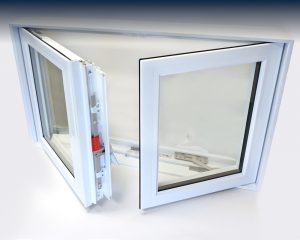
Casement windows are the most common and most effective egress window choice, particularly in basement applications. A single outward-swinging casement sash, when open, provides its full nominal sash area as unobstructed clear opening. Casements are easy to operate, open to 90°, and their crank mechanism is simple enough for a child to engage. A casement sash approximately 20 inches wide by 24 inches tall meets the minimum dimensional requirements, making compliance achievable even in relatively narrow wall openings.
Double-hung windows can qualify as egress windows, but they require a larger nominal sash size to deliver the required net clear opening, because only the lower (operable) sash counts toward the egress opening and the sash itself blocks part of the frame opening. A double-hung window must be significantly larger than the minimum opening dimensions to meet egress requirements — plan accordingly.
Sliding windows can meet egress requirements but, like double-hung windows, only one sash panel slides, providing half the total window width as the maximum clear opening. Sliding windows at or below grade also present a higher potential for debris obstruction of the track.
Awning windows — hinged at the top, opening outward at the bottom — are rarely used as egress windows because the maximum clear height of the opening is limited by the hinge position, making it difficult to achieve the required 24-inch clear height without a very large overall sash.
Fixed windows cannot serve as egress windows under any circumstances, as they provide no operable opening.
Basement Egress Windows: Special Considerations
Basement bedrooms present the greatest egress challenge because the wall opening is partially or fully below grade. Several factors specific to below-grade egress installations require careful planning:
Sill height — In a basement with a concrete foundation wall, the window sill is often 6–8 feet above the basement floor at the top of the foundation wall, far exceeding the 44-inch maximum sill height requirement. In these cases, a window well with a built-in ladder or step system is required, and the interior floor may need to be built up, or the window position must be carefully planned in new construction to achieve a compliant sill height.
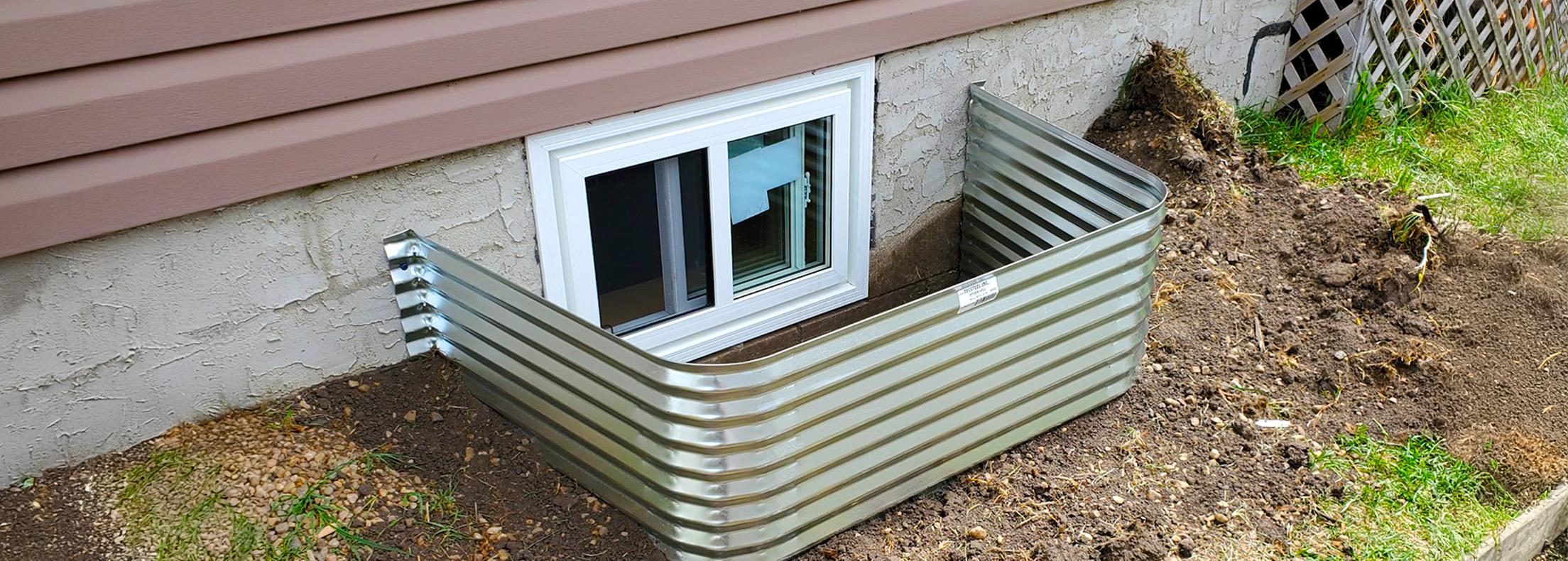
Window well sizing for egress — A standard decorative window well is not large enough to serve as an egress path. An egress-compliant window well must provide sufficient clear floor area in the well itself to allow an occupant to climb out. The IRC requires that an egress window well with a depth greater than 44 inches must be equipped with permanently affixed steps or a ladder. The well floor must also provide drainage to prevent water accumulation, which could impede egress.
Foundation cutting for retrofit installations — Converting an existing basement room to a code-compliant bedroom almost always requires cutting a larger opening in the foundation wall. This is a structural process — concrete or masonry must be cut and properly re-headed — that must be performed by qualified contractors with appropriate equipment. MILLENNIUM® coordinates with structural contractors for retrofit egress installations to ensure that the structural work and the window installation are properly integrated.
Natural light benefit — As a secondary benefit, a properly sized egress window in a basement bedroom delivers meaningful natural light to what is often an otherwise dark space. A well-sized casement egress window with an appropriately proportioned window well can transform the quality of light and the livability of a basement bedroom in addition to providing the required safety function.
Window Wells: Design and Requirements
A window well is a semicircular or rectangular retaining structure installed against the foundation wall around a below-grade window. It holds back the surrounding soil, creates an exterior air and light pocket adjacent to the window, and — when properly sized — serves as the means by which an occupant exits through the window in an emergency.
Standard window wells are sized simply to protect the window from soil contact, improve drainage, and allow modest amounts of natural light to reach the window. They are typically 24–36 inches in diameter and are not designed or sized for egress compliance. Installing a standard window well alongside a below-grade egress window does not automatically make the installation compliant — the well itself must meet size requirements.
Egress window wells are deeper and wider than standard wells, providing enough horizontal clear space in the well for an occupant to crouch, stand, and climb out. The well floor must drain effectively, and any well deeper than 44 inches from the window sill to the well floor must include permanently affixed, easily graspable steps or a ladder built into the well wall. Well covers — grates or panels that keep debris and precipitation out while still allowing emergency exit — must be openable from inside the well without tools or special knowledge.
Well drainage is important beyond code compliance. A poorly drained window well accumulates water that can infiltrate around the window frame, saturate the surrounding soil, increase hydrostatic pressure on the foundation wall, and contribute to basement moisture and mold problems. Proper installation includes a gravel drainage bed at the well floor connected to a drain tile or drainage system that carries water away from the foundation.
Aesthetic integration — A well-designed egress window well does not have to be an eyesore. Stone, brick, or manufactured polymer well liners in various profiles integrate naturally with different foundation and landscape styles. Plantings, river rock, and well covers in decorative finishes can make an egress well a considered part of the landscape rather than an afterthought.
MILLENNIUM® Egress Window Specifications
MILLENNIUM® designs, fabricates, and installs egress windows in all three frame series, in casement, double-hung, and sliding configurations, sized and verified to meet IRC minimum requirements and applicable local code amendments.
Double Pane Low-E Insulating Glass — Standard in all MILLENNIUM® egress windows. Two panes of glass sealed with an argon gas-filled cavity and Low-E coating, providing the same energy performance as any MILLENNIUM® product. Egress windows that are also energy-efficient are the standard, not the exception.
Tempered Glass — Required by code in many egress window applications, particularly where the window sill is within 18 inches of the floor or the window is adjacent to a door. Tempered glass, approximately four times stronger than standard glass, fractures into small blunt fragments if broken — a critical safety property in a window that may need to be broken in an emergency if the operating mechanism fails.
Simple, Tool-Free Operation — All MILLENNIUM® egress windows are equipped with operating hardware that can be fully engaged and the window opened by one hand, without tools, keys, or excessive force. Crank mechanisms on casement egress windows are tested for smooth operation and accessibility. Hardware is specified for long-term reliable function — an egress window that seizes or sticks is a failed safety device.
Multi-Point Locking — Standard security locking that nonetheless disengages fully and simply from the interior with a single handle movement, meeting the tool-free operation requirement while providing normal day-to-day security.
Warm Edge Spacer Bars and Butyl Rubber Seals — As standard across all MILLENNIUM® products, egress window insulating glass units use warm edge spacer bars rather than aluminum to minimize thermal bridging at the glass edge, and butyl rubber perimeter seals for long-term moisture resistance.
A Note on Compliance Responsibility
MILLENNIUM® provides egress windows that meet IRC dimensional requirements when installed correctly in a compliant rough opening at a compliant sill height. However, overall egress compliance involves the complete installation — the window, the rough opening dimensions, the sill height above finished floor, the window well size and drainage where applicable, and the local jurisdiction’s specific requirements. Confirming that the complete installation is code-compliant is the responsibility of the project’s licensed contractor and the local building official, not the window manufacturer alone. MILLENNIUM® strongly recommends obtaining a building permit for any egress window installation, both to ensure compliance is verified by a qualified inspector and to protect the homeowner’s record of compliance for future insurance and resale purposes.
Contact MILLENNIUM® Windows and Doors to discuss your egress window project. We will help you identify the right window type, verify dimensional compliance, coordinate the rough opening and window well requirements, and handle professional installation from start to finish.
Phone: 918-582-5025