What Is a Hopper Window?
A hopper window is a single-sash window hinged at the bottom of the frame that opens by tilting inward at the top, pivoting on its lower hinge points. When opened, the top of the sash swings toward the interior of the room while the bottom remains fixed — the opposite of an awning window, which is hinged at the top and opens outward at the bottom. The name comes from the resemblance of the open sash to the tilted intake of a grain or coal hopper.
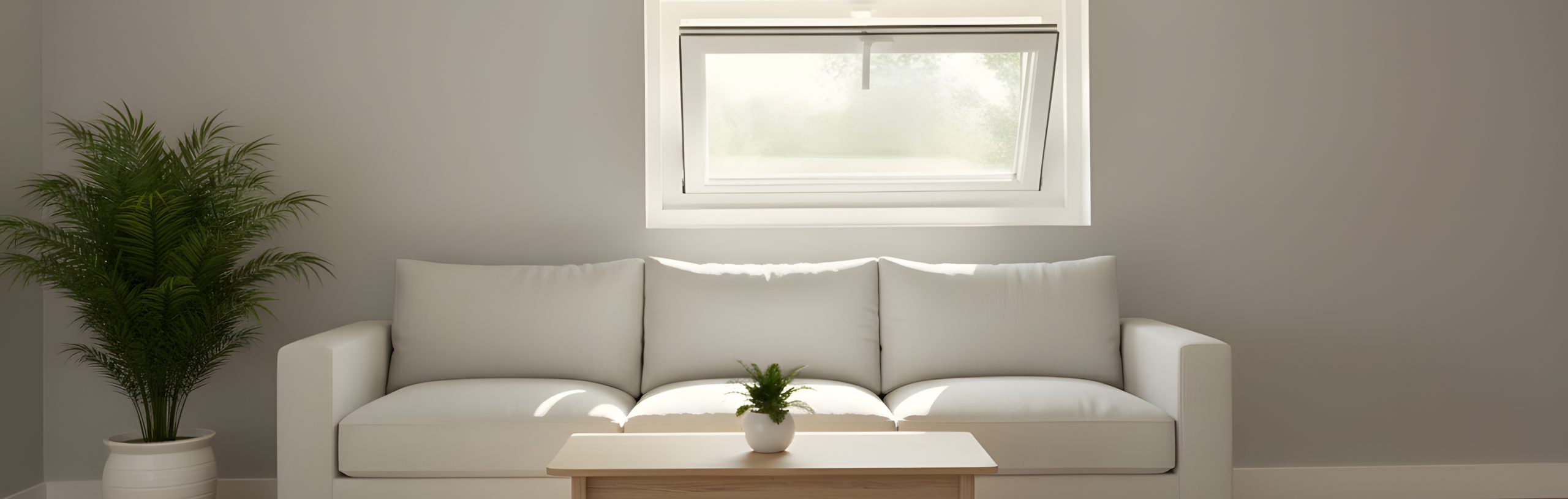
This bottom-hinged, inward-tilting configuration gives the hopper window two defining characteristics that suit it specifically to the applications where it is most commonly used: it directs incoming air upward into the room rather than straight inward at floor level, and it is highly resistant to rain infiltration because the opening faces downward and inward rather than upward or outward.
How a Hopper Window Differs from Similar Types
Hopper windows are closely related to two other window types — awning windows and casement windows — and are frequently confused with both. Understanding the distinctions is important for specifying the right window for each application.
Hopper vs. Awning An awning window and a hopper window are mirror images of each other in terms of hinge placement. An awning window hinges at the top and opens outward at the bottom, like the protective awning its name references. A hopper window hinges at the bottom and opens inward at the top. The practical consequences of this difference are significant:
Awning windows are better suited to exterior wall applications because they can be left open during rain without admitting water — the open sash acts as a roof over the opening. Hopper windows are better suited to tight or below-grade spaces because they open inward and therefore require no exterior clearance. An awning window installed in a basement or close to grade would require clear exterior space to swing outward; a hopper window in the same location requires only interior clearance.
Both window types provide good air direction — awnings direct air upward from below the sash, hoppers direct air upward from above the tilted sash — but the hopper’s inward opening makes it more suitable for spaces where exterior swing clearance is limited or unavailable.
Hopper vs. Casement A casement window hinges on a vertical side and swings horizontally. A hopper hinges at the bottom and tilts on a horizontal axis. For wide, short openings — the typical format of a basement or utility room window — a hopper window naturally fits the horizontal proportion of the opening in a way that a casement, which would need to be very wide and very short to fill the same space, cannot do as effectively. A casement also requires more lateral wall clearance when open; a hopper requires only inward vertical clearance.
Hopper vs. Tilt-Turn A tilt-turn window offers both functions in a single sash: it can tilt inward at the top on a horizontal axis (like a hopper) for restricted ventilation, or swing fully open on a vertical axis (like a casement) for maximum ventilation and egress access. For applications where both ventilation modes are desired in the same opening, the tilt-turn is the more versatile choice. Where the restricted, controlled tilt ventilation of a hopper is all that is required — and where cost and simplicity are priorities — the dedicated hopper window is the more appropriate specification.
Where Hopper Windows Are Used
Basements The basement is the most common application for hopper windows, and for good reasons that go directly to the hopper’s mechanical design advantages. Basement windows are typically installed in short, wide openings near the top of the foundation wall, close to or below exterior grade. The inward-opening hopper sash requires no exterior clearance — it opens into the basement interior, where ceiling height is available. The sash, when open, deflects incoming air upward toward the ceiling rather than directly across the floor, improving air circulation throughout the space. The bottom-hinged design is inherently rain-resistant: precipitation strikes the exterior face of the glass and runs downward off the sill rather than being scooped into the opening as it would be in an upward-opening window.
For basement applications, hopper windows pair naturally with window wells — the retaining structures installed against the foundation wall to hold back surrounding soil and create an exterior air and light pocket adjacent to the window. A hopper window with a properly sized window well provides ventilation, natural light, and — when sized to meet IRC egress requirements — can also serve as an emergency egress opening. See the Egress Windows page for the specific minimum dimensions required for egress compliance.
Utility Rooms and Laundry Rooms Utility and laundry rooms generate significant moisture, heat, and airborne particulates from washing, drying, and mechanical equipment. Effective ventilation in these spaces is important for comfort, air quality, and the prevention of mold and moisture damage. A hopper window positioned high on the wall — above the appliances or equipment — allows warm, moist air near the ceiling to escape through the tilted upper portion of the open sash while fresh air enters. The high installation position also provides ventilation without compromising the privacy of a typically interior-facing room.
Bathrooms Privacy and ventilation are the competing requirements in bathroom window design, and the hopper addresses both effectively. A hopper window installed high on the bathroom wall — above eye height from the exterior — provides meaningful ventilation while maintaining privacy without frosted glass or window treatments. The inward-tilting sash directs incoming air away from the occupant at floor level and toward the ceiling where moisture and warm air accumulate. In bathrooms without mechanical exhaust fans, a hopper window high on the wall is often the most effective passive ventilation solution available.
Garages Garages accumulate exhaust fumes, paint and solvent vapors, and heat from parked vehicles and equipment. A hopper window — or a pair of hopper windows on opposite walls — provides the cross-ventilation needed to manage these air quality concerns without requiring powered exhaust fans. The durable, secure construction of a hopper window also suits the functional aesthetic of a garage environment, and the inward-opening sash is compatible with shelving and storage against the wall beneath the window.
Above Doors and Windows — As Transoms A hopper window installed above an interior door — in the transom position — is the historically authentic configuration of the American interior transom window. As described on the Transom Windows page, interior transoms above closed doorways allow air to circulate between rooms while maintaining acoustic privacy, and a bottom-hinged inward-tilting sash in this position is the most practical operable configuration: it opens into the room above head height, directs air circulation upward, and can be operated with a simple chain or pole without requiring the sash to project into a high-traffic area below.
Industrial, Commercial, and High-Bay Applications Hopper windows are widely used in commercial and industrial buildings — warehouses, manufacturing facilities, gymnasiums, and high-bay utility spaces — positioned near the top of tall walls or in clerestory positions. In these applications, the combination of high installation position (where manual operation would be impractical without mechanical assistance) and controlled ventilation opening angle suits the needs of large spaces where window operability is infrequent and the primary requirement is reliable, secure, weather-resistant performance.
Ventilation Performance and Opening Angle
A hopper window is specifically a controlled-ventilation window. Its opening angle is intentionally limited — typically to a maximum of 45° — by the geometry of the hinge and the depth of the frame reveal. This limited opening angle serves several purposes: it controls the volume and velocity of incoming air, preventing drafts in cold or wet conditions; it keeps the open sash from projecting excessively into the room’s usable space; and it maintains the structural integrity of the opening by preventing the sash from reaching an angle at which the hinge hardware would be placed under excessive leverage stress.
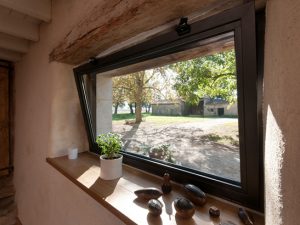
For applications where maximum ventilation is occasionally required — a garage during a heat event, a utility room after a plumbing repair — the limited opening angle of a hopper can be a constraint. In these cases, a casement window or tilt-turn window is the better choice. The hopper is optimized for regular, controlled, moderate ventilation rather than maximum-capacity air exchange.
The direction of airflow through an open hopper window is consistently upward — incoming air enters through the gap between the tilted top of the sash and the frame head, deflects off the tilted sash face, and rises toward the ceiling. This upward deflection is beneficial in most hopper applications: in basements, it drives air circulation through the full height of the space; in bathrooms, it carries moisture toward the ceiling and toward any exhaust point; in laundry rooms, it dilutes heat and vapor before they settle at occupant level.
Security
A hopper window’s limited opening angle and inward-tilting sash geometry provide inherent security advantages in addition to their ventilation function. The tilted sash, even when fully open, does not create an opening large enough for a person to climb through in most standard hopper window sizes — the opening is bounded by the width of the frame and the angle of the tilt, not by the full sash dimensions. This means a hopper window can be left open for ventilation without creating an accessible entry point, which is a meaningful security consideration for basement and ground-level utility room windows that are often in less visible locations.
All MILLENNIUM® hopper windows include multi-point locking hardware that engages simultaneously at multiple points along the sash perimeter when the window is closed, providing security performance comparable to any other window type. The locking mechanism is operated from the interior and cannot be accessed from outside when the window is closed.
Energy Performance
The hopper window’s four-sided compression seal — when closed, the sash presses against a continuous perimeter weatherstrip on all four sides of the frame, similar to a casement window — provides excellent airtightness. Unlike sliding windows or hung windows, which maintain clearance between the sash and frame for operation, a hopper window achieves a tight, uniform seal around its full perimeter when latched. This makes hopper windows among the better-performing operable window types for air infiltration resistance, with performance approaching that of casement windows.
MILLENNIUM® hopper windows include double-pane Low-E insulating glass with argon gas fill, warm edge spacer bars, and butyl rubber perimeter seals as standard. The Low-E metallic coating limits heat transfer through the glass in both directions — reducing heat loss in winter and solar heat gain in summer — while maintaining high visible light transmittance. For basement and below-grade applications, the energy performance of the window is especially important because the surrounding soil and foundation wall create a thermal mass environment in which the window is the primary source of both heat loss and heat gain.
Tempered glass is standard in hopper window applications where the sill height, location relative to walking surfaces, or code requirements mandate it — typically in basement installations where the window may be at or near floor level of the occupied space above.
Installation Notes
Hopper windows are installed in the same manner as any other window type — set into a prepared rough opening, shimmed level and plumb, anchored to the framing, and sealed at the perimeter with appropriate flashing and air-barrier materials. For below-grade basement installations, the exterior perimeter seal and flashing are critical: the window sits at the base of or within the foundation wall, where hydrostatic pressure and soil moisture create a more demanding waterproofing environment than above-grade installations. MILLENNIUM® installations in below-grade applications include appropriate exterior sill flashing and perimeter sealant to manage this condition.
The inward-opening sash requires interior clearance equal to the depth of the sash projection at maximum open angle. For a typical hopper window with a sash height of 18 inches opened to 45°, the interior projection at the top of the sash when fully open is approximately 13 inches. Shelving, appliances, or cabinetry installed below the window should be set back at least this distance to allow full operation of the sash without obstruction. In tight utility room installations, this clearance requirement should be incorporated into the layout planning before the window position is finalized.
MILLENNIUM® Frame Series
A-Series — Thermally Broken Aluminum Extruded aluminum frame with a polyamide thermal break separating interior and exterior aluminum profiles. Maximum structural rigidity and corrosion resistance — the appropriate choice for below-grade, high-humidity, and utility applications where long-term durability with no maintenance is the priority. Available in the full MILLENNIUM® powder coat color palette.
M-Series — Aluminum Exterior / Wood Interior Aluminum exterior cladding with a natural wood interior surface. The aluminum exterior handles the moisture and UV exposure of below-grade and utility environments without maintenance; the wood interior provides a warmer, more finished appearance suitable for installations in livable spaces — a finished basement bedroom, a renovated utility room that opens to the main living area.
W-Series — Solid Wood / Aluminum Exterior Cladding Solid wood frame with aluminum exterior cladding. Appropriate for installations where the interior wood finish is a design priority and the application conditions are not excessively demanding — finished basement living areas, laundry rooms in well-maintained residential environments, and interior transom applications above doorways.
Contact MILLENNIUM® Windows and Doors for a free consultation and appraisal. We will help you identify the right size, frame series, glazing specification, and hardware for your hopper window application — whether it is a single basement replacement, a series of utility room units, or a complete interior transom installation.
Phone: 918-582-5025