What Is a Storm Window?
A storm window is a supplementary window installed over or inside an existing primary window to provide an additional layer of protection against wind, rain, driving precipitation, and temperature extremes. Unlike a full window replacement, a storm window works in combination with the existing window unit, creating a second barrier that improves the overall thermal, acoustic, and weather resistance performance of the opening without requiring the structural work of a complete replacement installation.

Storm windows are also specified as primary windows in their own right for new construction and renovation projects in climates subject to severe weather — high winds, tropical storm conditions, coastal exposure, and tornado-prone regions. In these applications, the storm window designation refers not to a secondary unit but to a window designed and tested to specific wind resistance, water tightness, and air permeability performance classes.
MILLENNIUM® designs and manufactures custom storm windows for both applications — as supplementary protective units and as primary high-performance windows for severe weather environments — in all three frame series, to the exact dimensions and performance specifications required by your project and location.
Why Storm Windows Matter: The Climate Context
Weather intensity in North America has increased measurably over the past several decades. Extreme wind events, severe thunderstorm systems, and tornado activity affect a broad swath of the continental United States — not only coastal regions but interior states including Oklahoma, where MILLENNIUM® is based. Tulsa sits within Tornado Alley, one of the most tornado-active regions in the world, and regularly experiences severe spring and early summer storm systems capable of generating winds well in excess of 100 mph, large hail, and driving rain.
Windows are the most vulnerable element of any building envelope in severe weather. They are the point of least resistance to wind pressure, the most likely source of water infiltration during driving rain events, and — critically — a potential breach point that, once failed, allows wind pressure to enter and act on the interior of the building structure. A window that fails in a high-wind event does not merely admit water; it can allow wind pressure to build inside the structure in ways that compromise the roof, walls, and overall structural integrity. Specifying windows with appropriate wind resistance ratings for your location is not a luxury — it is a fundamental building safety decision.
Understanding Wind Resistance: The Performance Classes
The resistance of a window to wind load is its single most important performance characteristic in severe weather environments. Wind pressure acts on a window in two directions: positive pressure pushing inward on the face of the window as wind strikes it directly, and negative pressure (suction) pulling outward on the leeward side of the building. A properly tested storm window must resist both.
How Wind Resistance Is Measured
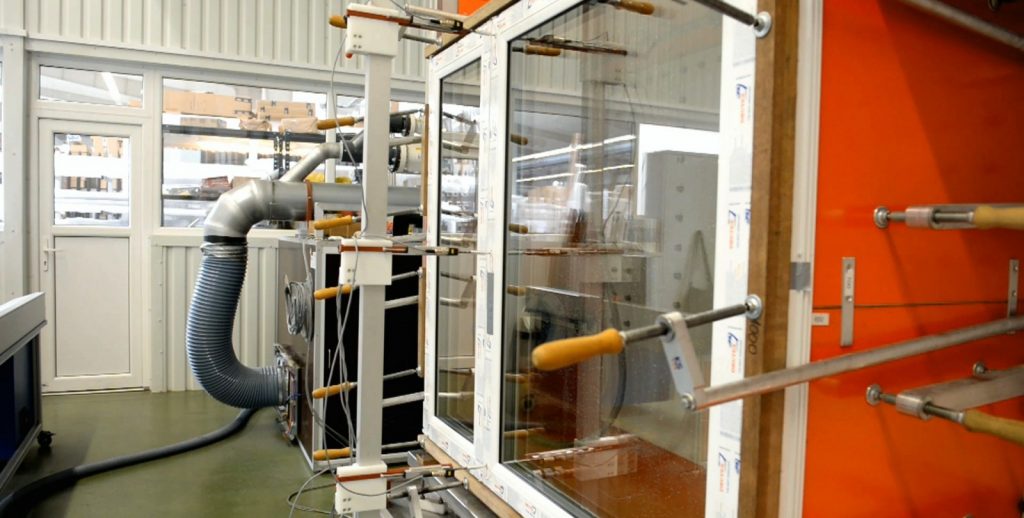
Wind resistance performance is evaluated in laboratory testing by applying a series of controlled positive and negative reference pressures to the window assembly and measuring the resulting deflection of the frame and sash. The critical limit is that the maximum deflection of any element must not exceed 1/300 of that element’s length. Beyond this deflection limit, permanent deformation of the frame can occur, the weatherstrip seal can be compromised, and the structural integrity of the glazing bite — the depth to which the glass is captured by the frame — may be reduced.
Testing follows a three-stage sequence:
First, reference pressures are applied to establish the deflection characteristics of the window. Second, 50 repeated cycles of positive and negative pressure at half the reference value are applied to assess resistance to fatigue — a window that passes the initial test but fails under repeated loading is not acceptable for real-world conditions where storm winds are not single brief events but sustained and fluctuating loads. Third, a safety test applies a single cycle of pressure at 1.5 times the reference value to evaluate the performance of the hardware and fittings under overload conditions — the point at which failure, if it occurs, will be localized to the hardware rather than the frame or glass.
The European Classification System (EN 12210)
The international standard most commonly referenced for window wind resistance classification is EN 12210, which uses an alphanumeric system to rate window assemblies:
Class A-1 is the minimum — a window in this class will reach its maximum allowable deflection at a wind speed of approximately 90 km/h (56 mph). This is not adequate for severe weather environments.
Classes B-3 and B-4 are appropriate for standard residential construction in areas subject to normal to moderately elevated wind exposure — wind pressures of approximately 800–1000 Pa, corresponding to wind speeds in the 160–175 km/h (100–109 mph) range at the point of maximum allowable deflection.
Classes C-3 and C-4 are recommended for elevated exposure conditions: high-floor apartments, isolated houses in open terrain, coastal locations, and regions within tornado-risk zones. These classes resist wind pressures of 1200–1600 Pa, corresponding to wind speeds of approximately 158–184 km/h (98–114 mph) at the deflection limit.
Class C-5 is the most demanding standard rating, and Class C-6 — the maximum available rating — certifies that the window will reach its deflection limit only at wind speeds exceeding 205 km/h (127 mph).
What This Means in Practice for Oklahoma
The Enhanced Fujita scale classifies tornadoes from EF0 (65–85 mph wind speeds) through EF5 (over 200 mph). EF0 and EF1 tornadoes — which represent the large majority of tornado events — produce wind speeds that a properly specified B-3 or B-4 class window will resist at or near its design limit. EF2 events (111–135 mph) require C-3 or C-4 class windows. For the highest risk applications, impact-resistant laminated glazing combined with C-5 or C-6 class frames provides the best available protection short of dedicated hurricane or tornado shelter construction.
MILLENNIUM® will advise on the appropriate wind resistance class for your specific location, building height, exposure category, and local building code requirements.
Water Tightness: The Second Critical Parameter
Wind resistance and water tightness are closely linked performance characteristics — a window that flexes under wind load will simultaneously open gaps in its weatherstrip seal, allowing water infiltration. For this reason, water tightness performance is always evaluated and rated alongside wind resistance.
Water tightness is tested by simultaneously applying air pressure and water spray to the exterior face of the window at specified rates and pressures, then inspecting the interior for any water penetration. Performance is classified on a scale from Class 1A (minimal water resistance, suitable for protected locations) through Class E900 (the highest available rating, for extreme exposure conditions). The rating system accounts for both the pressure at which water begins to penetrate and the volume of water spray applied during testing.
For residential applications in storm-prone regions, a minimum Class E450 water tightness rating is recommended — this corresponds to resistance against wind-driven rain at positive pressures of 450 Pa, approximately equivalent to a wind speed of 95 km/h driving rain directly against the window face.
The intersection of wind resistance class and water tightness class defines the overall weather performance envelope of a window. Both must be appropriate for the installation location — a window with excellent wind resistance but poor water tightness will flex without breaking while admitting significant water infiltration during storm events.
Air Permeability: The Third Parameter
Air permeability — the rate at which air passes through a closed and latched window under a given pressure differential — is the third performance parameter that defines storm window quality. It affects both energy efficiency and comfort: a window with high air permeability allows drafts, reduces thermal performance, and can admit wind-driven moisture vapor even when no liquid water penetrates.
Air permeability is classified from Class 1 (highest infiltration rate, lowest performance) through Class 4 (the tightest, lowest infiltration rate available). Class 4 is the recommended specification for storm windows in severe weather environments and for any application where energy efficiency and comfort are priorities.
The operating style of the window significantly affects its achievable air permeability class. As discussed across MILLENNIUM®’s window pages, casement windows — which close with a four-sided compression seal — achieve the lowest air permeability of any operable window type. Double-hung and sliding windows, which must maintain clearance between the sash and frame for operation, cannot achieve as tight a seal and will have higher air permeability ratings at equivalent frame quality. For the most demanding storm window applications, casement or fixed window configurations are preferred.
Impact Resistance: Beyond Wind Load
In regions subject to hail, wind-borne debris, and tornado conditions, wind resistance alone does not fully characterize the protection a window provides. Impact resistance — the ability of the glazing and frame to resist penetration by wind-borne projectiles — is an additional performance dimension that is distinct from static wind load resistance.
Impact-resistant glazing uses laminated glass construction: two or more panes of glass bonded together with a polyvinyl butyral (PVB) or ionoplast interlayer. When struck by a projectile, the glass panes fracture but the interlayer holds the fragments in place, preventing penetration of the opening. This is the same fundamental construction used in windshields and in the MILLENNIUM® ballistic-resistant glazing line, though at a different performance level appropriate for storm and impact conditions rather than ballistic threats.
Laminated impact glass provides four layers of protection simultaneously: it resists penetration by wind-borne debris; it maintains the sealed envelope of the building even after impact (preventing the interior pressurization that can structurally compromise a building in tornado conditions); it holds together without creating dangerous shards if the glass surface is cracked; and it provides significantly better acoustic performance than non-laminated glass of equivalent thickness.
MILLENNIUM® storm windows are available with laminated impact-resistant glazing as a standard or upgrade option depending on the performance class specified.
Storm Windows as Energy Performers
A common misconception is that storm windows are purely defensive products — heavy, opaque barriers that sacrifice light and aesthetics for protection. MILLENNIUM® storm windows are full-performance insulating window units that meet the same energy specifications as the rest of our product line.
Every MILLENNIUM® storm window includes double-pane Low-E insulating glass as standard. The Low-E metallic coating reduces glass surface emissivity to as low as 0.02–0.04, limiting heat transfer through the glazing in both winter and summer. Argon gas fill between the panes reduces convective heat transfer within the insulating glass unit cavity by approximately 10–15% compared to air fill. Warm edge spacer bars minimize thermal bridging at the glass perimeter. Thermally broken aluminum frames in the A-Series eliminate the thermal conductance pathway through the frame itself.
The result is a storm window that delivers genuine energy performance — U-factors in the 0.25–0.35 range — alongside its weather resistance function. Protection and efficiency are not in tension; they are both consequences of well-engineered, high-quality construction.
Selecting the Right Storm Window for Your Location
The appropriate storm window specification depends on several site-specific factors that should be evaluated before any purchase decision:
Building height and exposure — Windows on upper floors of multi-story buildings are subject to significantly higher wind pressures than ground-floor windows in the same location, because wind speed increases with height and there are fewer surrounding obstructions to reduce the effective wind load. A window appropriate for a single-story residential installation may be significantly underspecified for a fifth-floor application in the same building.
Terrain and surrounding environment — Isolated houses in open terrain, properties at the top of hills or ridgelines, coastal properties exposed to ocean winds, and houses at the edge of open fields or prairies all experience higher effective wind loads than houses in sheltered suburban neighborhoods with consistent building and tree coverage.
Local building code requirements — Many jurisdictions in tornado-prone, hurricane-affected, and high-wind regions have mandatory minimum window performance requirements built into their residential building codes. MILLENNIUM® verifies applicable local requirements for every project and ensures that specified products meet or exceed the minimum code standard.
The certification requirement — A manufacturer’s specification sheet is not a substitute for independent test certification. Every window MILLENNIUM® sells for storm-resistance applications is certified to its stated performance class by independent laboratory testing, and documentation of this certification is provided with the product. Before purchasing any storm window from any manufacturer, request the independent test certificate — not the marketing specification sheet — and verify that the tested product matches exactly what is being sold and installed.
MILLENNIUM® Frame Series for Storm Applications
A-Series — Thermally Broken Aluminum Aluminum is the preferred frame material for high wind resistance applications due to its exceptional strength-to-weight ratio and dimensional stability under load. MILLENNIUM® A-Series frames use extruded aluminum profiles engineered for rigidity, with wall thicknesses and reinforcement profiles selected to meet C-class wind resistance requirements. The polyamide thermal break maintains full structural continuity while eliminating the thermal bridging that would otherwise make an untreated aluminum frame energy-inefficient. Available in powder coat finishes rated for long-term coastal and UV exposure.
M-Series — Aluminum Exterior / Wood Interior The aluminum exterior of the M-Series provides the weather resistance and structural performance appropriate for storm window applications, with the warm wood interior offering comfort and design flexibility inside.
W-Series — Solid Wood / Aluminum Exterior Cladding The aluminum exterior cladding of the W-Series protects the wood frame from moisture, UV, and mechanical damage, delivering appropriate weather resistance while preserving the natural insulating and aesthetic properties of the wood interior.
Glass Specifications
Standard — Double-pane Low-E insulating glass with argon gas fill, warm edge spacer bars, and butyl rubber perimeter seals. Tempered glass as required by code.
Impact Upgrade — Laminated impact-resistant glass with PVB interlayer on the exterior pane (or both panes for maximum protection), combined with double-pane insulating glass unit construction. This specification provides both impact resistance and full thermal insulating performance in a single assembly.
Ballistic-Resistant — Available for the highest security applications. See the Bullet Resistant Glass Windows page for full UL 752 level specifications.
Contact MILLENNIUM® Windows and Doors for a free consultation and appraisal. We will evaluate your location’s wind exposure, applicable local code requirements, and performance class needs, and recommend the right storm window specification for your project.
Phone: 918-582-5025