The Door Reimagined.
A standard hinged door rotates around its edge. A pivot door rotates around a point — a concealed axis set away from the edge of the panel, supported by precision hardware recessed into the floor and the head frame above. This single mechanical difference produces a door that moves differently, looks different, and makes a completely different architectural statement from any conventionally hinged door.
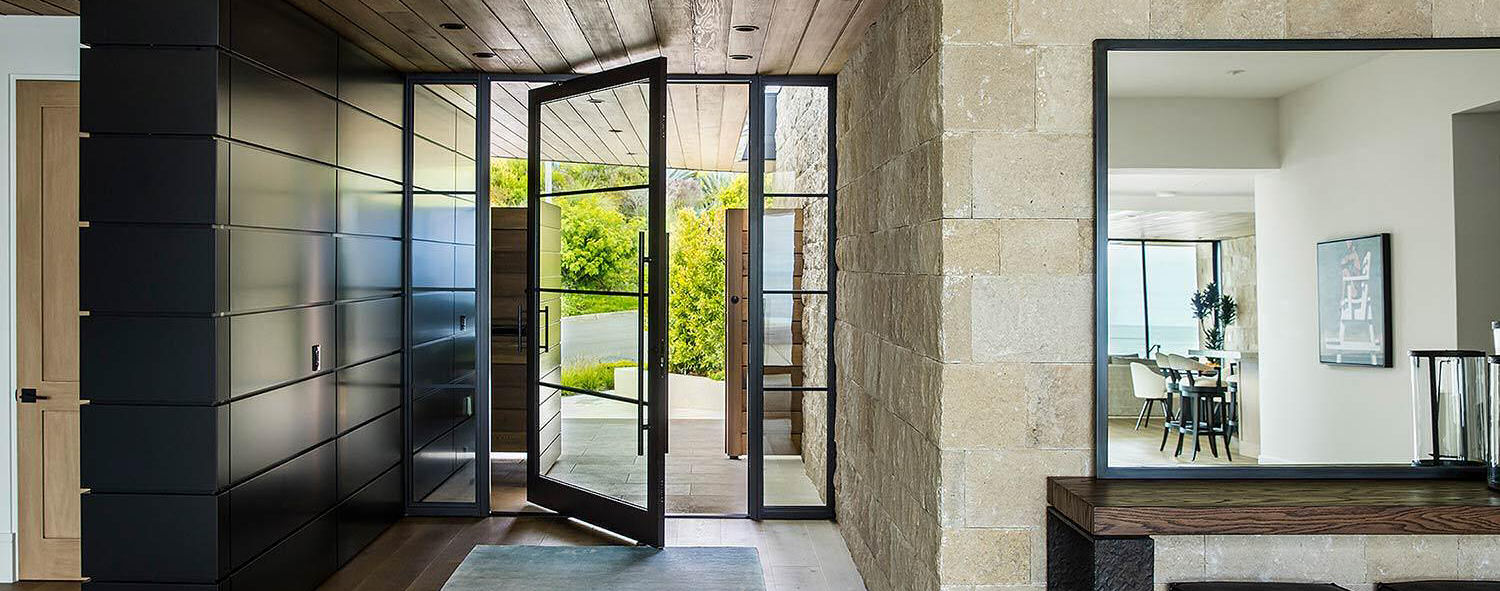
Where a standard door swings from one side and disappears against the adjacent wall when open, a pivot door rotates symmetrically — part of the panel sweeping inward, part sweeping outward simultaneously — with a fluid, balanced motion that reads as deliberate and unhurried. The absence of visible hinge barrels on the door face or frame, the typically oversized panel dimensions, and the quality of movement that precision pivot hardware produces combine to make a pivot door one of the most architecturally powerful single elements available in contemporary residential and commercial design.
MILLENNIUM® pivot glass doors are custom fabricated in the A-Series thermally broken aluminum frame, in fully glazed, partially glazed, and composite glass-and-panel configurations, for both exterior entry and interior applications.
The Pivot Mechanism: How It Works
A pivot door is supported at two points on a vertical axis — a floor pivot set into the finished floor surface, and a head pivot or overhead pivot carrier set into the door head frame above. The door panel hangs between these two points, rotating freely around the axis they define. Unlike a conventional hinge, which is mounted at the door’s edge and bears only lateral load, the pivot mechanism bears the full weight of the door panel vertically and resists the full lateral load of wind pressure, panel weight eccentricity, and operational forces.
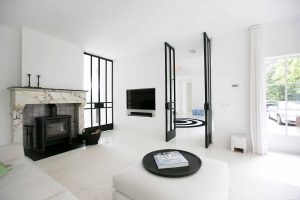
Pivot axis position is the primary design variable in pivot door specification. The axis can be positioned at several locations across the panel width, each producing a distinctly different visual and operational character.
An edge-offset pivot — the axis set 3 to 6 inches from one edge of the panel — produces movement most similar to a conventional hinged door. The small inner sweep on the hinge side is barely perceptible; the outer sweep is essentially the full panel width. This configuration suits larger panels where the full panel rotation would be impractical, and applications where the pivot aesthetic is desired without a dramatic inner sweep into the room.
A quarter-point pivot — the axis set at one-quarter of the panel width from one edge — produces a moderate inner sweep and a three-quarter outer sweep. This is the most common pivot door configuration for residential entry applications. The inner sweep is visible and contributes to the pivot door’s characteristic motion without projecting excessively into the adjacent interior space.
A center pivot — the axis set at the exact midpoint of the panel width — produces equal sweeps on both sides, rotating symmetrically inward and outward simultaneously. This configuration is the most visually dramatic and the most spatially demanding, requiring clear sweep space on both sides of the door. It is appropriate for very wide panels in high-ceiling spaces where the full symmetric rotation is part of the architectural intent.
Hardware load rating must be matched to the panel dimensions and weight. A standard residential pivot door panel — 36 to 42 inches wide, 8 feet tall, fully glazed — weighs 150 to 250 pounds depending on glass specification. An oversized pivot door — 48 to 60 inches wide, 10 to 12 feet tall — can weigh 400 to 600 pounds or more. MILLENNIUM® selects pivot hardware with load ratings matched to each panel’s specific dimensions and glass weight, with a safety factor appropriate to the operational demands of the installation.
Floor pivot installation is the most critical and least reversible step in a pivot door project. The floor pivot must be set precisely on the correct axis — plumb, at the correct distance from the door face, and at the correct floor elevation — before the finished floor is installed around it. Any error in the floor pivot position cannot be corrected after the floor finish is complete without removing and repouring the surrounding floor. MILLENNIUM® sets all floor pivot hardware during the rough construction phase, verifies alignment before flooring installation, and protects the pivot during floor finishing.
Exterior Pivot Doors
An exterior pivot door faces every demand that any exterior door must meet — weather resistance, thermal performance, security, and long-term mechanical reliability — while adding the specific structural challenges of the pivot format: a very large panel spanning a full-height opening, bearing its own weight and wind load on two pivot points rather than distributed across multiple hinges.
Panel size and structural performance: Exterior pivot door panels are typically taller and wider than standard hinged doors. Heights of 8, 9, 10, and 12 feet are common; widths of 36 to 60 inches are standard for single-panel pivot doors. At these dimensions, the panel is a substantial structural element. The frame profiles must be engineered for the bending loads imposed by wind pressure across the full panel area, the torsional loads imposed by the eccentric pivot point, and the weight of the glass unit itself. MILLENNIUM® A-Series exterior pivot door frames are engineered to these specific structural requirements for each custom panel dimension.
Weather sealing: The perimeter seal of an exterior pivot door — the weatherstrip that seals the gap between the rotating panel and the fixed frame when the door is closed and locked — must accommodate the rotational motion of the panel at the pivot points while maintaining a continuous compression seal around the full perimeter. Standard door weatherstrip systems designed for side-hung doors do not transfer directly to pivot door geometry. MILLENNIUM® exterior pivot doors use perimeter weatherstrip systems specifically configured for pivot door geometry, with the compression seal maintained consistently around the full perimeter including the pivot corners.
Threshold: As with all large exterior glass doors, the threshold of an exterior pivot door is the most demanding weather detail. The floor pivot is recessed below the threshold surface, and the sill weatherstrip must seal against the bottom rail of the panel at a location that allows the panel to rotate without binding while preventing water infiltration under the door when closed. MILLENNIUM® exterior pivot thresholds integrate the floor pivot housing with a thermal break sill profile and drainage provisions appropriate to the exposure conditions of the installation.
Locking: Exterior pivot doors use multi-point locking systems engaging the fixed frame at the head and sill — and at intermediate points on the latch stile for taller panels — when the handle or locking actuator is engaged. The latch stile of a pivot door engages the fixed frame on the side opposite the pivot axis. The locking geometry is different from a standard hinged door because the panel approaches the frame at an angle during closing rather than in a straight lateral motion — the locking hardware must be calibrated for this rotational closing path to ensure that all locking points engage simultaneously and fully.
Interior Pivot Doors
Interior pivot doors serve a different set of objectives from exterior doors — thermal performance and weather resistance give way to spatial definition, visual character, light transmission, and acoustic performance as the primary design criteria.
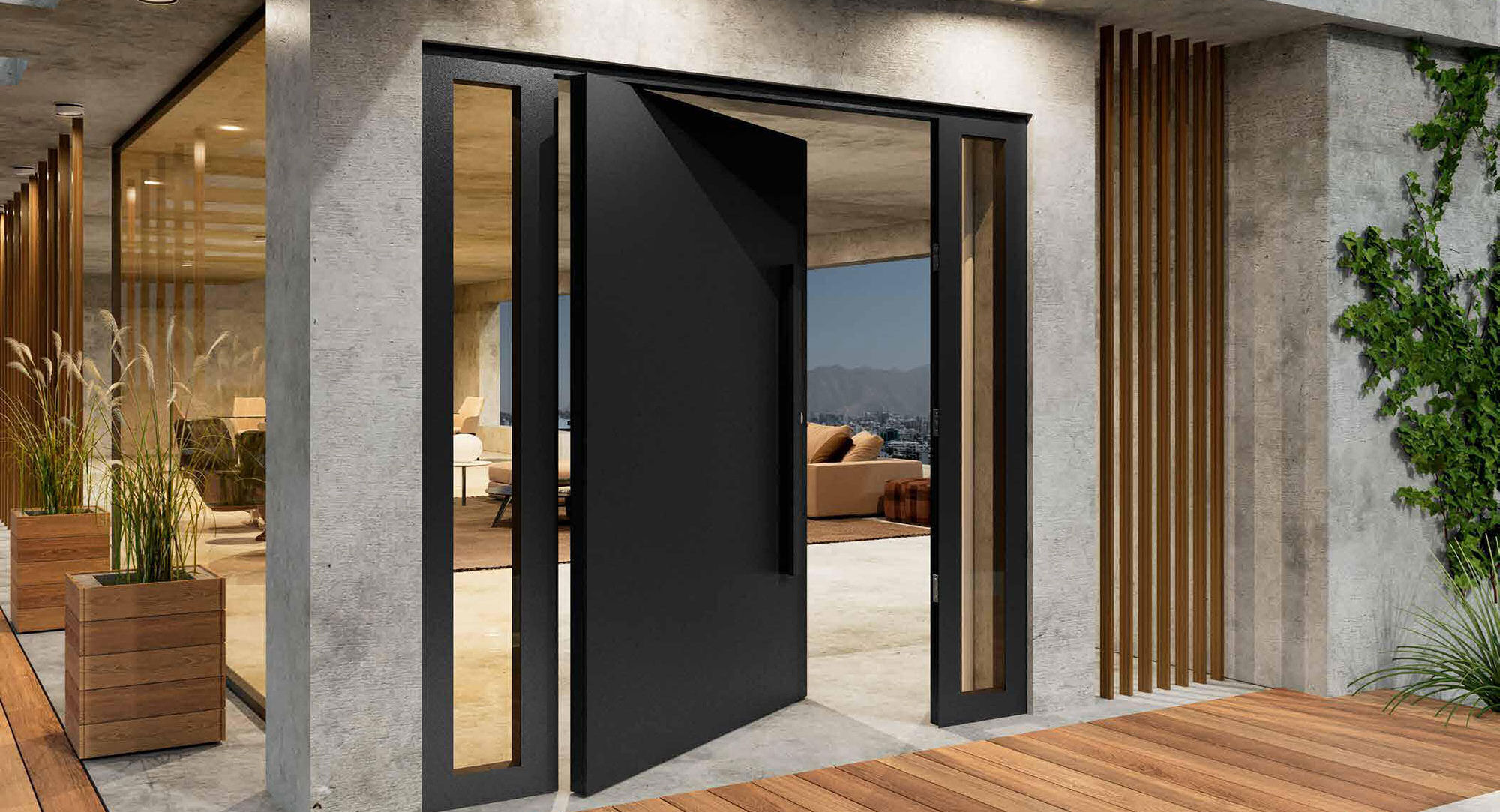
As room dividers: A large interior pivot door between two rooms — a living room and a dining room, a study and a library, a master bedroom and a dressing room — creates a boundary that is defined by the quality of its presence rather than by its opacity. A fully glazed interior pivot door divides space acoustically and spatially while maintaining complete visual connection between the rooms. A frosted or partially glazed panel creates visual privacy while admitting light. A solid panel with a glazed accent creates division with a controlled visual connection.
The pivot format is particularly effective for interior room dividers because the panel can be very wide — 48, 54, or 60 inches — without the weight or operational challenges that a wide hinged door would present. A wide pivot door sweeping open creates a generous, unhurried architectural transition between spaces that a narrow door cannot produce regardless of its quality.
As office and commercial partitions: Glass pivot doors are widely used in commercial interior design — office suites, conference rooms, reception areas, retail spaces — where the door is a design element as much as a functional partition. The glass panel transmits light between spaces that would otherwise be separated by opaque walls, maintaining the visual openness of an open-plan environment while providing acoustic and physical separation when needed. The pivot format, with its distinctive motion and absence of visible hardware, reinforces the design quality of a high-specification commercial interior.
As passage doors in high-ceiling spaces: In residential great rooms, double-height entries, and loft spaces where ceiling heights exceed 10 or 12 feet, a standard 8-foot door reads as undersized and awkward against the full ceiling height. A full-height pivot door scaled to the room — 10, 11, or 12 feet tall — completes the proportional relationship between the door and the space it serves. Only the pivot format is practically suited to very tall interior doors, because the pivot mechanism supports the full panel weight at two points without the structural demands on the frame that a very tall side-hung door would impose on its hinges.
Glazing Options
Clear Low-E insulating glass — Standard for exterior pivot doors. Maximum transparency, Low-E thermal and UV performance, double-pane construction. For interior pivot doors where thermal performance is not required, single-pane clear glass in the appropriate thickness for the panel dimensions is available.
Frosted and sandblasted glass — A uniformly matte surface that scatters transmitted light, providing visual privacy while maintaining full light transmission. Sandblasted glass can be specified at varying opacity levels — from a light translucency that reveals silhouettes to a near-opaque white surface. For interior pivot doors between spaces where light sharing is desired and visual privacy is required, frosted glass is the most effective single glazing specification.
Tinted glass — Body-tinted glass in grey, bronze, or blue-green reduces both solar heat gain and visible light transmittance through a colorant within the glass itself. For exterior pivot doors facing intense western sun, tinted glass can provide glare and heat reduction that Low-E coating alone does not fully address. Tinted glass also gives the exterior face of the door a distinctive visual character — a grey or bronze tinted pivot door in a dark aluminum frame reads as a monolithic architectural element from the exterior.
Patterned and textured glass — Reeded, fluted, ribbed, or custom textured glass provides privacy comparable to sandblasted glass with a distinct decorative character. Linear textured glass — particularly reeded and fluted patterns — is currently one of the most architecturally relevant glazing choices for interior pivot doors in contemporary residential design, providing visual interest and privacy simultaneously.
Laminated safety glass — Standard on all exterior pivot door panels and recommended for large interior pivot doors. The PVB or ionoplast interlayer holds glass fragments together after breakage — essential for large glass panels that are handled directly by occupants and that, if broken, would present a serious safety hazard from falling fragments. For exterior security applications, laminated glass on both panes with an ionoplast interlayer provides meaningful forced-entry resistance.
Decorative and art glass — Etched, carved, leaded, or custom designed glass panels for applications where the door glazing is a primary design expression. Custom etched designs can range from subtle surface textures to bold figurative or geometric compositions occupying the full panel. Leaded glass compositions — traditional or contemporary — are available for period renovation projects and for new construction where a distinctive handcrafted glazing element is the design intent.
Ballistic-resistant glazing — Available for the highest security applications. See the Bullet Resistant Glass page for full UL 752 level specifications.
Frame and Panel Configurations
Fully glazed aluminum frame — A slim aluminum perimeter frame enclosing the full glass panel. The frame is visible only at the perimeter; the glass occupies the full visual field of the door. This is the most contemporary and most minimalist configuration — the door reads primarily as a plane of glass, with the frame as a precise graphic border. MILLENNIUM® A-Series fully glazed pivot door frames are available in the full powder coat color palette, with dual-tone finishes — different exterior and interior colors — available as standard.
Composite glass and panel — The door panel combines a glazed upper section with a solid lower panel — or a central glazed section within a solid surround — creating a composition that offers privacy, impact resistance, or design character that a fully glazed panel does not. The solid panel sections can be aluminum-skinned with foam insulation core for exterior applications, or solid wood for interior applications where the material character of wood is part of the design intent.
Steel frame pivot doors — For applications where the industrial character of a steel frame is the architectural intent — loft conversions, contemporary industrial interiors, commercial spaces — steel frame pivot doors provide a visual weight and material honesty that aluminum cannot replicate. Steel frames are heavier than aluminum and require appropriate corrosion protection for exterior applications. MILLENNIUM® coordinates steel frame pivot door fabrication for projects where this specification is appropriate.
MILLENNIUM® Pivot Door Specifications
Frame — A-Series thermally broken aluminum for exterior and thermally unbroken aluminum for interior applications. Steel frame available for specific applications. Full powder coat color palette, dual-tone available.
Pivot hardware — European precision pivot hardware, floor and head pivot, rated for the specific panel weight and dimensions of each custom door. Load ratings from standard residential (to approximately 400 lbs panel weight) to heavy-duty commercial (to 1,000 lbs and above). Hardware is non-handed — the same hardware suits left and right pivot configurations — and non-adjustable after installation, making precise setting during rough construction essential.
Panel dimensions — Heights from standard 84 inches to full floor-to-ceiling custom heights. Widths from 30 to 72 inches for single-panel pivot configurations. Panels beyond these dimensions require engineering review of both the hardware specification and the structural conditions at the floor and head pivot bearing points.
Locking — Multi-point locking on exterior pivot doors engaging the fixed frame at head, sill, and intermediate latch points. Mortise lock with lever or pull handle for interior pivot doors. Electronic access control integration available for commercial applications.
Contact MILLENNIUM® Windows and Doors for a free consultation and appraisal. Pivot door projects require careful coordination of pivot axis position, hardware load rating, floor pivot installation timing, glazing specification, and structural conditions — our team manages all of these from initial design through completed installation.
Phone: 918-582-5025