The Case for Sliding.
Every other exterior glass door type opens by moving some portion of its panel out of the wall plane — swinging outward, folding, rotating. A sliding glass door opens by moving its panel within the wall plane, translating horizontally along a track without projecting into the interior or exterior space on either side. This is its defining functional advantage and the reason sliding glass doors remain the most widely specified large-format exterior door in residential construction: they require no swing clearance whatsoever, on either side of the opening, at any point during operation.
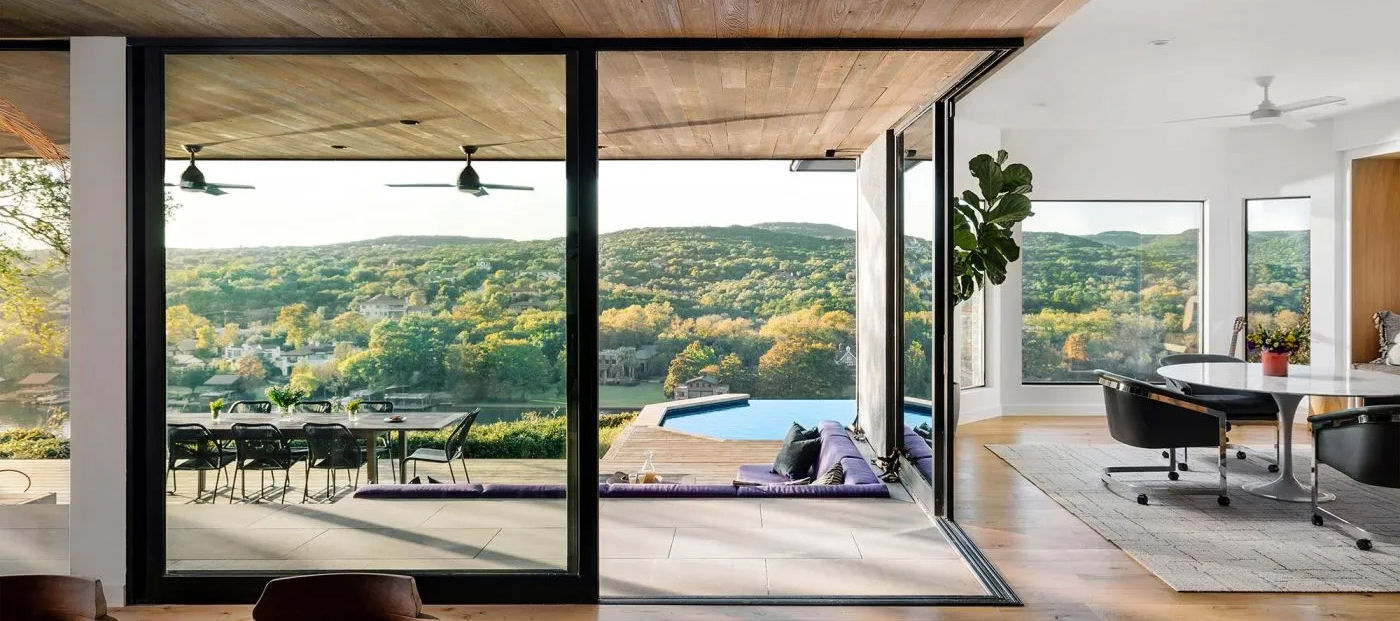
In the locations where sliding doors are most commonly installed — between a living room and a rear terrace, between a kitchen and a garden, between a bedroom and a private balcony — this absence of swing clearance is not a minor convenience. It is the difference between an opening that works in the available space and one that does not. A terrace with a railing, a kitchen with an island close to the exterior wall, a balcony too narrow for a swinging door — these are the conditions where a sliding door is not merely preferable but often the only practical operable opening option.
MILLENNIUM® sliding glass door systems are custom fabricated in the A-Series thermally broken aluminum frame in four configurations — standard sliding, lift-and-slide, pocket sliding, and multi-panel sliding — each suited to a distinct set of spatial, performance, and architectural requirements.
Standard Sliding Doors
The standard sliding door consists of one fixed panel and one sliding panel within the same frame, the sliding panel traveling in a track to overlap the fixed panel when open. The operating panel rolls on precision stainless steel roller carriages along a bottom track, guided by a top channel that prevents lateral movement without bearing the panel weight. When fully open, the sliding panel overlaps the fixed panel, and the clear opening — the unobstructed passage width — equals approximately half the total door width.
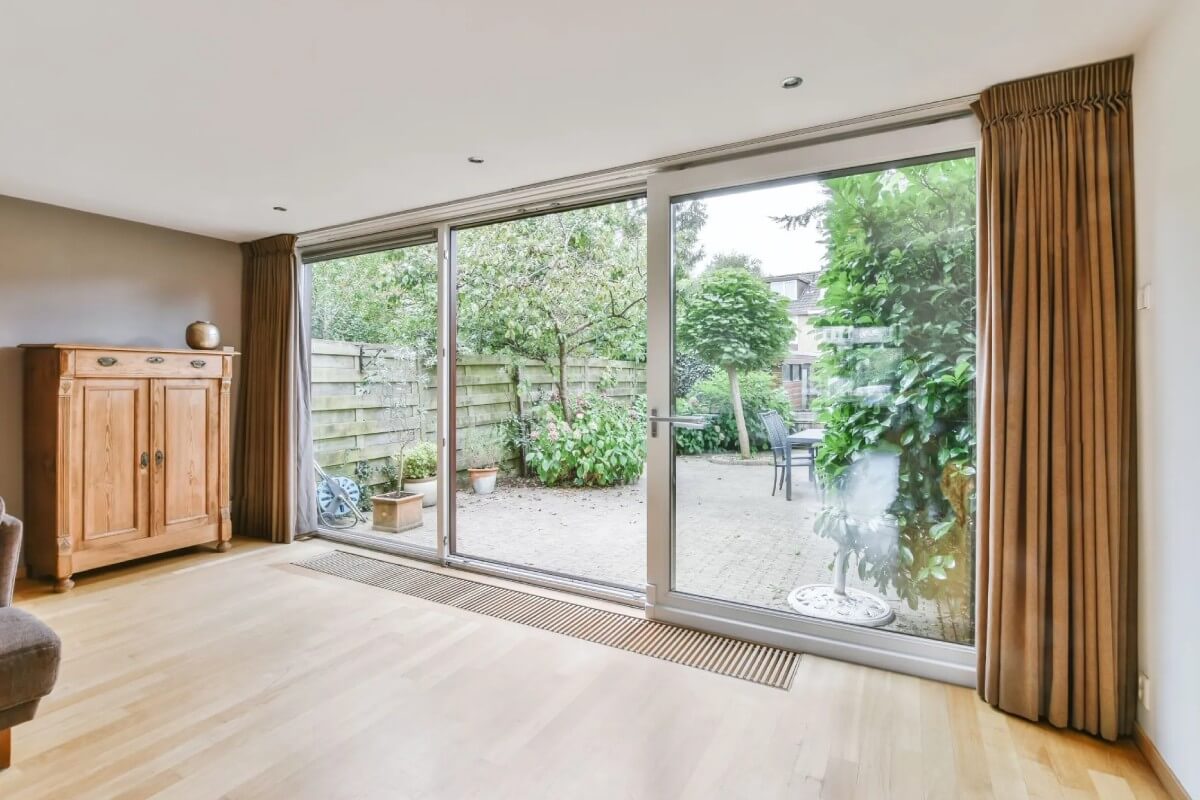
This is the most familiar and most common sliding door configuration, and it is the correct specification for a large majority of residential terrace and garden door applications. Its simplicity is a genuine performance attribute: fewer mechanical components means fewer points of potential failure, simpler maintenance, and lower initial cost compared to more complex sliding systems.
Panel proportions in a standard sliding door are typically square to slightly taller than wide — a 6-foot-wide by 8-foot-tall unit is a common residential specification. Wider units — 8, 9, or 10 feet — are available and common in open-plan residential applications where the connection to the exterior terrace is a primary design element of the living space. At widths beyond 8 feet, the sliding panel weight and the structural demands on the track and roller system require careful hardware specification — MILLENNIUM® selects roller carriage capacity matched to the specific panel weight of each custom unit.
The fixed panel in a standard sliding door is not merely a filler — it is a full-performance fixed window unit sharing the same frame as the operating panel. Its glazing specification matches the sliding panel. Its frame profile is continuous with the sliding panel frame. From the interior, the fixed and sliding panels read as a unified glazed wall divided only by the meeting stile where the two panels overlap.
Lift-and-Slide Doors
A lift-and-slide door is the performance-engineered evolution of the standard sliding door. The mechanical difference is in the operating sequence: when the handle is turned to the open position, a cam mechanism simultaneously lifts the panel slightly off its compression weatherstrip seal and engages the roller carriages. The panel can then be moved along the track with minimal effort — the panel is rolling freely rather than dragging against its seal. When the panel is returned to the closed position and the handle is turned to lock, the cam mechanism lowers the panel back down into full compression against the perimeter weatherstrip, driving all locking points into engagement simultaneously.
This lift-and-lower operation produces two performance advantages that standard sliding doors cannot match.
Airtightness approaching casement performance. A standard sliding door panel maintains a clearance between its bottom rail and the sill track at all times — it must, or it could not slide. This clearance is bridged by a brush seal or pile weatherstrip that provides reasonable but imperfect air sealing. A lift-and-slide door, when locked down into its closed position, compresses a full perimeter elastomeric seal — top, bottom, and both sides — with no clearance remaining anywhere. The result is air infiltration performance significantly better than any standard sliding system and comparable to a high-quality casement window.
Effortless operation at large panel weights. Very large sliding panels — 6 feet wide, 10 feet tall, triple-pane glazed — can weigh 800 pounds or more. A panel of this weight dragging against a bottom weatherstrip would be extremely difficult to operate. Lifted clear of its seal on precision roller carriages, the same panel moves with light, even effort from a single hand on the handle. The lift-and-slide mechanism makes large-format glazed panels practically operable that would otherwise require unacceptable physical effort.
For any sliding door installation where thermal performance, airtightness, or large panel dimensions are priorities, lift-and-slide is the correct specification. MILLENNIUM® recommends lift-and-slide as the standard specification for all sliding glass door projects where the panel dimensions or performance objectives exceed the comfortable range of a standard sliding system.
Pocket Sliding Doors
A pocket sliding door disappears entirely when open. Rather than overlapping a fixed panel within the same frame, the operating panel slides into a cavity — a pocket — within the adjacent wall, so that when fully open the door panel is completely concealed within the wall construction and the opening is entirely clear. No panel is visible on either side of the opening. The wall beside the door appears, when the door is open, as though no door exists at all.
The pocket door achieves a level of spatial openness that no other door type can match. A living room with a pocket door to the terrace, when the door is open, has no visual interruption at the opening edge — the interior and exterior floor planes, wall planes, and ceiling planes are visually continuous. The door does not exist in the user’s perception when open. This is the most complete possible dissolution of the boundary between inside and outside.
Construction requirements are the primary constraint of the pocket sliding door. The pocket cavity must be framed into the wall during construction — it cannot be retrofitted into an existing wall without removing and rebuilding the wall section adjacent to the opening. The wall containing the pocket must be thick enough to accommodate the door panel plus the track system and framing on each side, typically 6 to 8 inches of wall depth for a standard panel thickness. The pocket wall cannot contain structural elements, plumbing, electrical conduit, or ductwork that would interfere with the panel travel — all of these must be routed around the pocket during construction planning.
For new construction projects where the pocket door is incorporated at the design stage, these constraints are straightforward to accommodate. For renovation projects, the structural and mechanical conditions of the existing wall adjacent to the opening must be carefully evaluated before a pocket door is specified. MILLENNIUM® evaluates all pocket door installation conditions during the design consultation and coordinates with the project’s structural and mechanical trades to confirm feasibility before the door is specified.
Performance considerations: The weatherstrip of a pocket door must seal the opening perimeter when the door is closed from a panel that approaches the frame laterally — the same geometric challenge as any sliding door — while the track that the panel travels on must extend from the opening into the pocket without interrupting the perimeter seal at the pocket opening edge. Quality pocket door systems resolve this with a header seal that spans the pocket entry and engages the top rail of the panel continuously as it travels between the pocket and the closed position.
Multi-Panel Sliding Systems
Multi-panel sliding systems use two, three, or more operating panels on one or more tracks, all sliding in the same direction or splitting to slide toward opposite sides of the opening. The purpose is to create larger clear openings than a single sliding panel can provide — and to do so without the folding complexity of a bi-fold system.
Two-panel opposing slide — Two operating panels, no fixed panel, each sliding toward the opposite side of the opening. When fully open, both panels are stacked at the opening edges and the full width of the opening is clear. The clear opening equals the full door width less the two stack widths. This configuration suits openings where maximum clear width is needed and the stack depth at each side is architecturally acceptable.
Three-panel slide — One fixed center panel flanked by two operating panels that slide toward the outer edges of the opening. The two operating panels provide ventilation and access while the fixed center panel provides the primary view. Alternatively, two sliding panels and one fixed outer panel, with both sliding panels traveling in the same direction to stack at one side — creating a large clear opening on one half of the total door width.
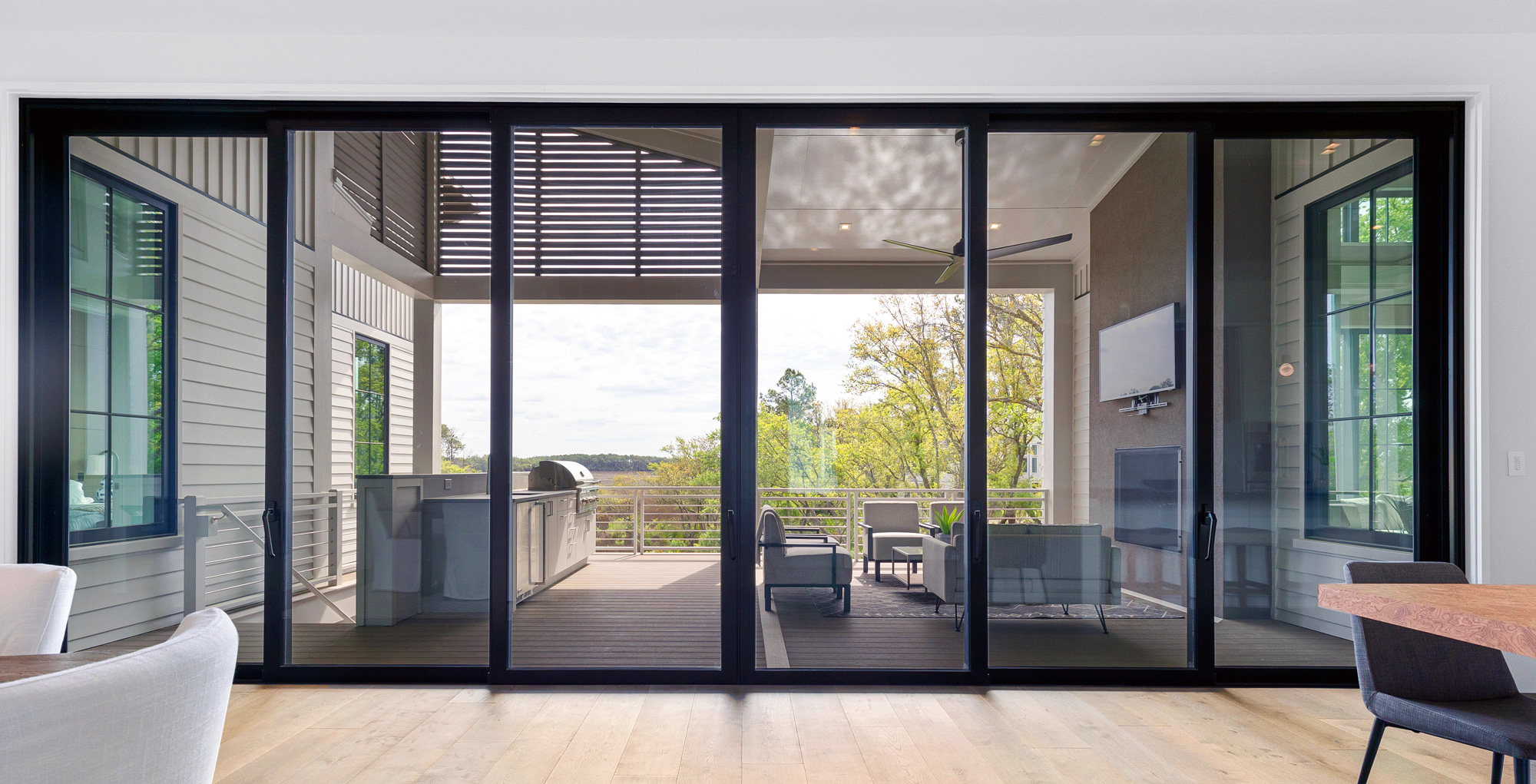
Four-panel slide — Four panels on two tracks, two per track, configured for various opening patterns. The most common four-panel configuration slides two panels to each side, creating a large center opening. Four-panel sliding systems are appropriate for wide openings — 12 to 20 feet — where a single or two-panel system would not provide sufficient clear opening width and where a bi-fold system’s folding complexity is not desired.
At multi-panel scale, the structural header above the opening, the track engineering, and the roller carriage specification all require careful design coordination. MILLENNIUM® manages this engineering coordination for every multi-panel sliding door project.
The Threshold: The Most Important Detail
The threshold of a sliding glass door — the sill assembly at the floor level through which the door panels travel — is the most important single detail in any sliding door installation. It determines the door’s weathertightness, its accessibility and ease of use, its long-term performance stability, and its visual integration with the interior and exterior floor finishes.
Height is the primary threshold concern for accessibility and usability. Any step at a sliding door threshold is a tripping hazard and an accessibility barrier. A flush threshold — one that brings the exterior and interior floor surfaces to the same level with only the track profile between them — is the ideal, but it requires careful waterproofing design to prevent bulk water from entering the building through the track profile during heavy rain. Low-profile thresholds that minimize the step height while maintaining adequate water management are the standard MILLENNIUM® specification for residential sliding door installations.
Drainage is the threshold’s primary weather performance function. The sill profile must collect and drain any water that reaches it — from wind-driven rain that enters around the panel seal, from condensation on the glass and frame surfaces, from water tracking in on the panel bottom rail during operation — without allowing it to accumulate and enter the interior. MILLENNIUM® sill profiles include integrated drainage channels and weep holes that manage this water continuously.
Thermal performance at the threshold requires a thermal break in the sill profile — the same design principle as the thermal break in the frame and panel profiles — to prevent the aluminum sill from becoming a cold bridge between the exterior and the interior floor surface. A thermally unbridged aluminum sill in cold weather becomes cold enough to cause condensation on the interior floor surface adjacent to the door. MILLENNIUM® thermally broken sill profiles eliminate this condensation pathway.
Security
Sliding glass doors are sometimes characterized as less secure than swinging doors because a standard sliding panel can theoretically be lifted off its bottom track from the outside if the anti-lift provisions are inadequate. This is a valid concern for low-quality sliding door systems and an important specification criterion.
MILLENNIUM® sliding glass doors address this through three independent security provisions. Anti-lift pins set into the top rail of the sliding panel engage the overhead track channel and physically prevent the panel from being lifted beyond the track engagement distance — far less than the clearance required to remove the panel from the track. Multi-point locking engages the fixed frame at the head, sill, and intermediate points simultaneously when the handle is turned to lock, distributing the locking resistance across the full height of the door rather than concentrating it at a single bolt. And the track and roller system is calibrated so that the panel, when locked, is drawn into firm contact with the perimeter weatherstrip — reducing the gap available to a prying tool at the meeting stile.
Laminated safety glass is standard on the interior pane of all MILLENNIUM® sliding door panels. The PVB or ionoplast interlayer holds glass fragments together after impact, deterring and slowing forced entry through the glazing. For higher security requirements, laminated glass on both panes, thicker interlayers, and ionoplast rather than PVB construction provide increasing forced-entry resistance.
Glazing Specification
Standard — Double-pane Low-E insulating glass with argon gas fill, warm edge spacer bars, and butyl rubber perimeter seals. Tempered glass on the exterior pane, laminated safety glass on the interior pane. Solar control or passive Low-E coating selected by door orientation.
Solar control — For south and west-facing sliding door installations, solar control Low-E coatings with a lower Solar Heat Gain Coefficient limit solar heat gain through the large glazed area. A wide sliding door facing west presents a significant solar aperture in late-afternoon summer conditions — glazing specification is the most cost-effective way to manage this load.
Triple-pane — Available as upgrade for maximum thermal and acoustic performance. Triple-pane panels are heavier than double-pane equivalents of the same size — the lift-and-slide system is recommended for all triple-pane sliding door applications to ensure smooth and consistent operation regardless of panel weight.
Acoustic — Asymmetric pane thicknesses in the insulating glass unit — different glass thicknesses on each pane — avoid the coincidence effect resonance dip that compromises acoustic performance at specific frequencies in symmetric units. For sliding door installations adjacent to traffic, mechanical equipment, or other significant noise sources, acoustic glass specification provides meaningful additional sound transmission loss across the full frequency range.
Laminated — Standard on interior pane. Available on exterior pane as upgrade for enhanced security and impact resistance.
Ballistic-resistant — Available for the highest security applications. See the Bullet Resistant Glass page for full UL 752 level specifications.
Frame Series and Finishes
A-Series — Thermally Broken Aluminum The standard and only MILLENNIUM® frame specification for sliding glass doors. Aluminum’s exceptional strength-to-weight ratio allows the slim panel profiles and precise dimensional tolerances that smooth sliding door operation requires. The polyamide thermal break in all frame, panel, and sill profiles eliminates thermal bridging throughout the assembly. Full MILLENNIUM® powder coat color palette. Dual-tone finishes — different exterior and interior colors — available as standard.
Sliding door panel profiles are engineered for the specific panel weight, width, and glazing specification of each custom unit — the profile depth, wall thickness, and corner connection details are not one-size-fits-all but are selected for the structural demands of each project.
Choosing the Right Sliding Door Configuration
The four MILLENNIUM® sliding door configurations are not interchangeable — each is the correct solution for a specific set of conditions.
Standard sliding is appropriate for the majority of residential terrace and garden door applications in the 6-to-10-foot width range where standard thermal performance is the objective.
Lift-and-slide is appropriate for any installation where panel dimensions are large, where maximum thermal and airtightness performance is required, or where the operating panel weight exceeds the comfortable range of a standard roller system.
Pocket sliding is appropriate for new construction projects where spatial openness and the complete visual disappearance of the door panel when open are the primary design objectives, and where the wall construction adjacent to the opening can accommodate the pocket.
Multi-panel sliding is appropriate for wide openings beyond the practical single-panel range where maximum clear opening width is needed and the folding complexity of a bi-fold system is not desired.
Contact MILLENNIUM® Windows and Doors for a free consultation and appraisal. Our team will evaluate your opening dimensions, spatial conditions, orientation, performance objectives, and architectural intent and recommend the sliding door configuration and specification that best serves your project.
Phone: 918-582-5025