Two Panels. One Opening. A Composition That Has Never Gone Out of Style.
The French door is among the most enduring architectural elements in Western residential design — not because it has resisted change, but because the problem it solves has not changed. How do you create a large, light-filled, formally composed opening between two spaces while preserving the visual definition and weather protection of a doorway? The answer, arrived at in 17th century France and validated by every architectural period since, is two full-height glazed panels hinged at opposite sides of the opening and meeting at the center.
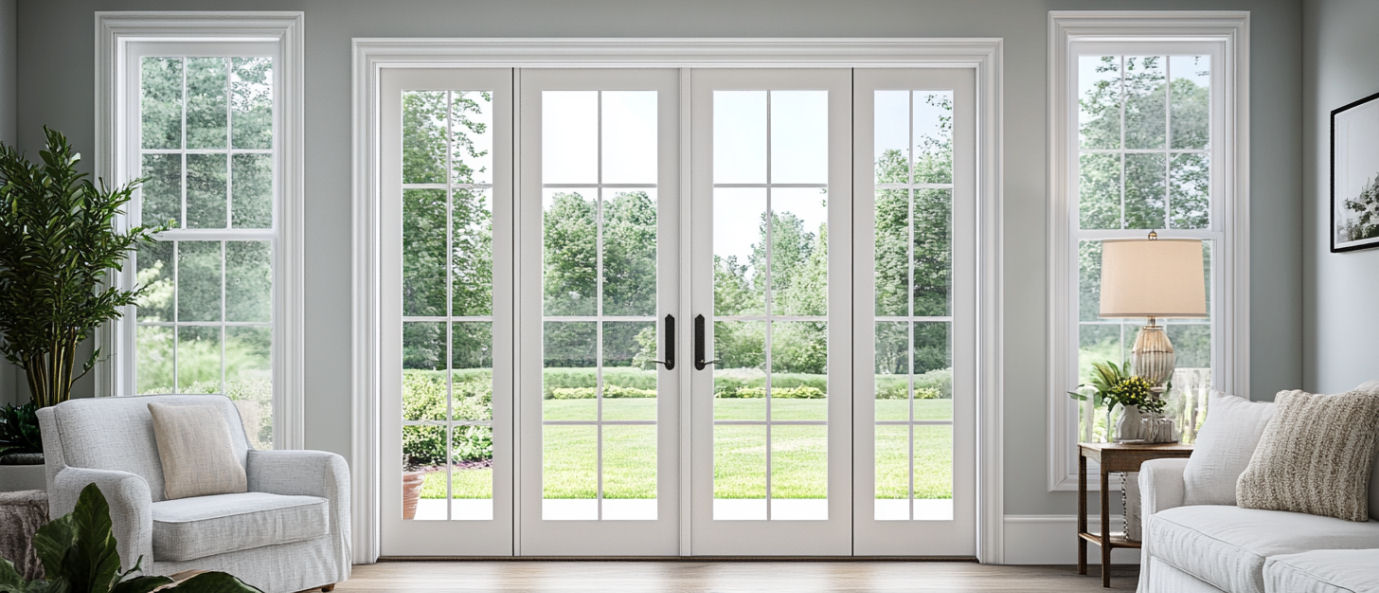
What has changed is the glazing. Where traditional French doors used divided lights — grids of small individual glass panes separated by narrow wood muntins — contemporary French doors use large, thermally engineered insulating glass units that span the full height and width of each panel with no internal divisions. The visual result is more open, more transparent, and more connected to the exterior than any traditional French door could achieve. The performance result — in thermal resistance, airtightness, UV protection, and security — is not comparable to anything available even twenty years ago.
MILLENNIUM® French doors are custom fabricated in the A-Series thermally broken aluminum frame and the M-Series aluminum-exterior / wood-interior frame, in any dimension within the structural limits of the panel, with the full range of glazing and hardware configurations described below.
How French Doors Work: The Mechanics
A French door unit consists of two independent door panels — an active panel that carries the locking hardware and is operated by the occupant, and a passive panel that is independently secured to the frame and released only when the full opening is needed. Both panels are hinged at their outer edges to the door frame; they meet at the center of the opening at their inner edges, which are called the meeting stiles.
The active panel operates exactly as a standard hinged single door — the handle is turned, the multi-point locking mechanism releases, and the panel swings open on its hinges. For everyday use, only the active panel needs to be opened. The clear opening width of the active panel alone is typically 30 to 36 inches — adequate for normal passage and furniture movement.
The passive panel is secured independently to the frame at the head and sill by flush bolts — vertical rods that engage keeps in the head frame above and the sill threshold below when driven home. When the full opening width is needed — moving large furniture, opening the doors fully for an event, creating the maximum indoor-outdoor connection — the passive panel’s flush bolts are retracted and the panel swings open on its own hinges, doubling the clear opening width to 60 to 72 inches or more depending on the unit dimensions.
This two-panel, independently-secured system means that the full opening width is always available when needed, while everyday use requires operating only the active panel — exactly like a standard single door.
The Meeting Stile: The Most Critical Detail
The meeting stile — the vertical edge where the two panels meet at the center of the opening — is the most structurally and thermally demanding detail in a French door assembly, and the detail that most clearly distinguishes a high-quality French door from a lower-quality one.
Structural performance at the meeting stile requires that the active panel, when locked, cannot be forced open by levering at the meeting stile edge — the point furthest from the hinges and therefore subject to the greatest mechanical advantage in a forced entry attempt. MILLENNIUM® French doors use multi-point locking on the active panel that engages the frame — not the passive panel — at the head, sill, and one or more intermediate points along the active panel’s latch side. The passive panel is independently secured by its own flush bolts at head and sill. The result is that both panels are independently anchored to the frame, and neither relies on the other for structural support or security resistance.
Thermal and weather performance at the meeting stile requires a continuous compression seal between the two panels when closed — a gasket on the meeting stile of each panel that compresses against the opposing panel’s surface when the active panel is locked. Without this compression seal, the center joint of a French door is an unweathered gap running the full height of the door — a significant air and water infiltration path. MILLENNIUM® French doors use a dual compression gasket system at the meeting stile, providing the same perimeter seal quality at the center joint as at the hinged edges, head, and threshold.
The threshold at the sill — the transition between the interior floor and the exterior — is the third critical detail. A French door threshold must be low enough for comfortable passage, weathertight enough to prevent water infiltration from wind-driven rain, and thermally broken so that the sill itself does not become a thermal bridge between the cold exterior and the warm interior floor. MILLENNIUM® French door thresholds incorporate a thermal break in the sill profile and a compression weatherstrip that engages the bottom rail of the active panel when closed.
Glazing Configurations
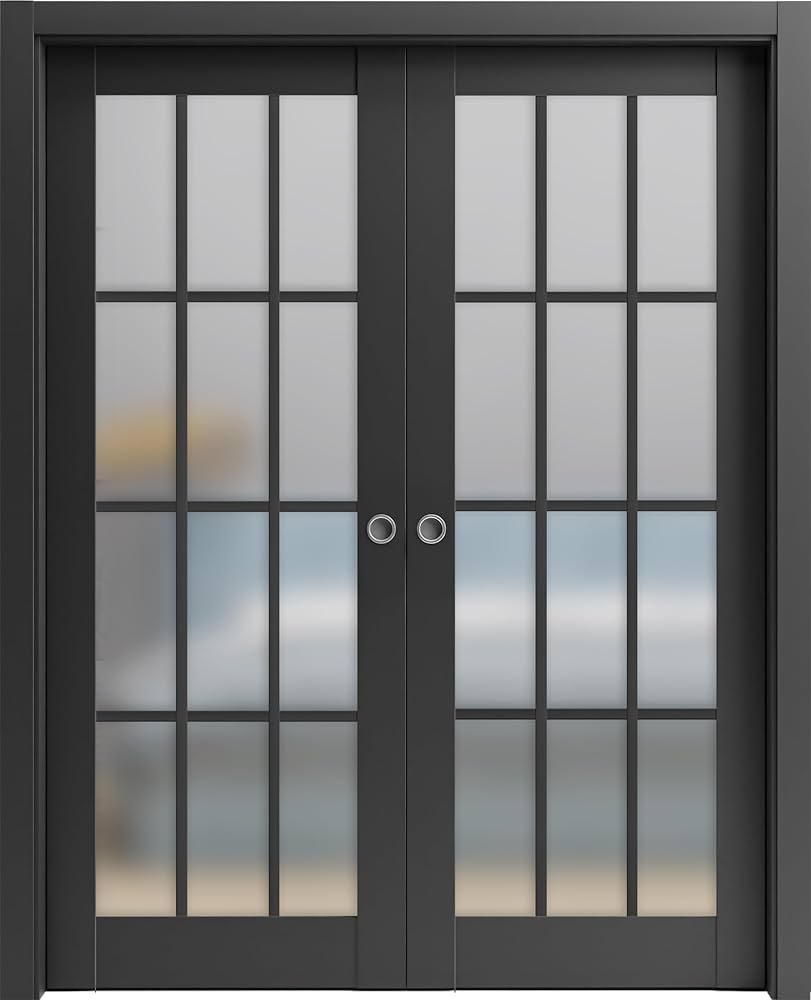
Fully glazed panels — contemporary configuration Each panel carries a single unbroken insulating glass unit spanning from the top rail to the bottom rail with no internal divisions. This is the most visually open configuration — maximum transparency, maximum light, uninterrupted view. The meeting stile and outer frame profiles are the only visual elements interrupting the glass. Most appropriate for contemporary, transitional, and modern architectural styles where the visual weight of traditional divided lights would be inconsistent with the facade character.
Divided light panels — traditional configuration Each panel carries multiple smaller glass panes separated by muntins — horizontal and vertical structural bars within the panel frame that divide the glazed area into a grid. Traditional French door divided light patterns are typically rectangular grids of six, eight, ten, or twelve panes per panel. The divided light configuration carries specific architectural associations: it is the authentic historic configuration of French doors in Federal, Colonial Revival, Georgian, and Victorian architecture, and it is the appropriate specification for renovation projects and new construction in these styles where authenticity to the period is a design priority.
MILLENNIUM® produces divided light French doors in both true divided lite construction — individual glass panes set in individual frame divisions — and simulated divided lite construction with applied grilles over a single insulating glass unit. True divided lites provide authentic shadow lines and glass edge reveals; simulated divided lites provide the visual pattern of divided lights with the superior thermal performance of a continuous insulating glass unit.
Contemporary horizontal division A single horizontal division — one bold bar across the panel at an asymmetric height, typically at two-thirds or three-quarters of the door height — creates a semi-divided composition that references the traditional divided light pattern without replicating it. This configuration suits transitional architectural styles and contemporary homes where a fully undivided panel feels too minimal and a traditional grid feels anachronistic.
Decorative and art glass The glazed panel — or a portion of it — filled with leaded, beveled, etched, or custom designed art glass. Decorative glass in French door panels is most effective in architectural styles where it carries historical precedent — leaded glass in Arts and Crafts and Victorian applications, beveled glass borders in Federal and transitional compositions. Custom etched designs can be incorporated into otherwise clear panels for a subtle decorative effect that maintains most of the panel’s transparency.
Privacy glazing Frosted or sandblasted glass in either the full panel or the lower portion of each panel, providing visual privacy while maintaining light transmission. Particularly relevant for French doors in interior applications — between a master bedroom and a dressing room, between a study and a corridor — where the light-sharing function of the glass is desired but full transparency is not.
French Doors in Exterior Applications
Rear terrace and garden connections The most common residential application for French doors in new construction and renovation. A pair of French doors connecting the main living space to a rear terrace, deck, or garden creates an indoor-outdoor relationship that is visually richer than a sliding door — the two panels, when open, create a framed opening that reads as a deliberate architectural event rather than simply a gap in the wall. When both panels are open, the full 60-plus-inch clear opening allows free circulation between inside and outside for entertaining and family use.
Primary entry doors French doors as the primary entry to a house make a formal, symmetrical architectural statement appropriate for traditional and transitional homes with centered entry compositions. The bilateral symmetry of the two panels naturally suits a centered facade with balanced fenestration on each side of the entry. A French door entry is most effective when composed with a full surround — sidelights flanking both panels and a transom above — creating a generous glazed entry wall that announces the quality of the house from the street.
Transition between interior spaces French doors between interior rooms — dining room and living room, library and study, master suite and sitting room — are an underused design strategy that is gaining renewed attention as homeowners recognize the value of variable spatial connection. Closed, the French doors provide visual separation, acoustic privacy, and the formal definition of distinct rooms. Open, they dissolve the boundary and allow the two spaces to function as one. The glazed panels maintain the visual connection even when the doors are closed — the rooms remain visually linked while acoustically and functionally separated.
Entry Compositions with French Doors
A French door unit can be extended with fixed glazing on all sides to create a complete entry composition at architectural scale.
With sidelights — Fixed glazed panels flanking the French door unit on one or both outer sides extend the horizontal glazed area of the entry. Full-height sidelights flanking a French door create an entry composition that can span eight, ten, or more feet in total width — a major architectural element that reads from the street as a glazed wall rather than simply a door.
With transom — A fixed glazed panel above the French door unit, spanning its full width, extends the entry composition vertically and brings natural light into the entry hall at ceiling height. Transom profiles can be rectangular, arched, or elliptical, each carrying specific architectural associations appropriate to the style of the house.
Full surround — French doors with full-height sidelights on both outer sides and a transom spanning the full width above creates the most architecturally complete and formally resolved entry composition available in residential design. The combination is appropriate for traditional formal facades and for contemporary homes where the entry is intended as the primary design statement of the exterior.
Thermal and Energy Performance
French doors present a larger glazed area than any single-panel door of equivalent clear opening width, which makes glazing specification particularly important for thermal performance. MILLENNIUM® French doors are glazed with double-pane Low-E insulating glass with argon gas fill, warm edge spacer bars, and butyl rubber perimeter seals as standard, achieving U-factors in the range of 0.25 to 0.35 W/m²K — well within current U.S. energy code requirements and substantially better than typical residential door performance.
The orientation of the French doors significantly affects the appropriate Low-E specification. South-facing French doors benefit from passive Low-E coatings that admit winter solar gain while limiting summer overheating. West-facing French doors — subject to intense late-afternoon summer sun — benefit from solar control Low-E coatings with a lower SHGC. MILLENNIUM® selects the appropriate Low-E specification for every installation based on orientation and the thermal objectives of the project.
The thermally broken aluminum frame of the A-Series eliminates thermal bridging through the frame profile — the polyamide thermal break separating the interior and exterior aluminum sections ensures that the frame itself does not become a cold bridge between the exterior winter temperature and the interior conditioned space.
Triple-pane glazing is available as an upgrade, providing U-factors below 0.20 and meaningful additional acoustic insulation — appropriate for north-facing French door installations in cold climates, for acoustically sensitive applications, or for any project targeting near-zero energy performance levels.
Security
Multi-point locking is standard on all MILLENNIUM® French doors. The active panel engages locking points at the head, sill, and intermediate points along the latch stile simultaneously when the handle is turned. The passive panel is secured by flush bolts at head and sill that are set before the active panel is locked. Both panels are independently anchored to the frame, with no structural dependency between them.
All glazing is laminated safety glass at minimum on the interior pane. The PVB or ionoplast interlayer holds glass fragments together after impact — the door does not shatter and does not create an immediate penetrable opening when struck. For higher security requirements, laminated glass on both panes, thicker interlayers, ionoplast rather than PVB interlayers, and heat-strengthened outer panes provide increasing forced-entry resistance. Ballistic-resistant glazing is available for the highest security applications.
Frame Series and Finishes
A-Series — Thermally Broken Aluminum The standard specification for contemporary and transitional French doors. Slim meeting stile profiles minimize the visual interruption at the center of the opening. Dual-tone powder coat finish available — one color on the exterior face, a different color on the interior — allowing the exterior architectural expression to differ from the interior design context. Full MILLENNIUM® powder coat color palette including graphite, anthracite, bronze, white, and any RAL color.
M-Series — Aluminum Exterior / Wood Interior Aluminum exterior cladding with solid wood interior surfaces on both panels. The aluminum exterior handles weather, UV, and mechanical exposure without maintenance; the wood interior provides warmth and craftsmanship appropriate for traditional and transitional interior design contexts where the natural character of wood is a priority.
Contact MILLENNIUM® Windows and Doors for a free consultation and appraisal. Our team will work through your French door project — door dimensions, glazing configuration, surround composition, frame series, finish, and hardware — and produce a complete custom specification.
Phone: 918-582-5025