What Makes a Patio Door?
A patio door is a large-format glazed door system designed specifically for the transition between an interior living space and an exterior terrace, deck, garden, or outdoor living area. It is distinguished from a standard entry door by its scale — panel heights of 8 to 10 feet and total widths of 6 to 20 feet are common — by its glazing area, which is the primary design element rather than an accent, and by its functional purpose: creating a connection between inside and outside that is seamless, comfortable, and visually expansive when open, and thermally tight, weather-resistant, and secure when closed.
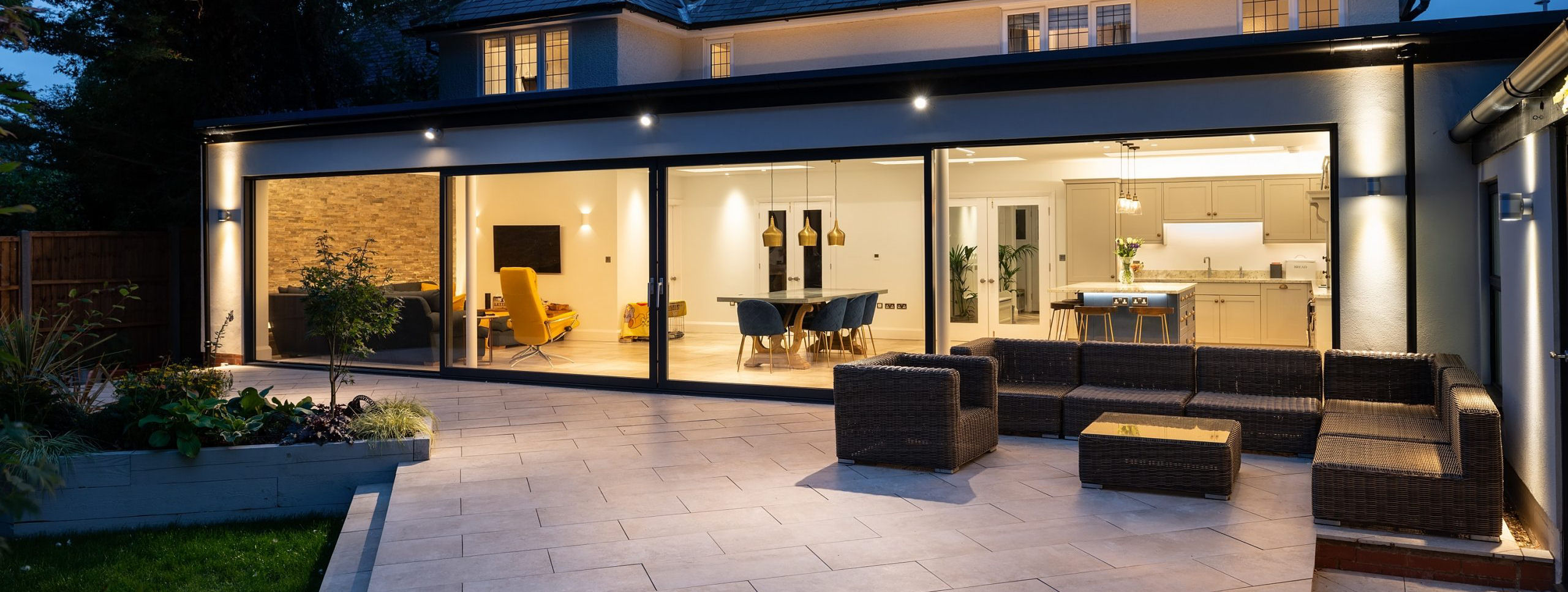
The patio door is often the largest single glazed element in a residential building. Its performance — thermal, acoustic, structural, and operational — has an outsized effect on the energy efficiency, comfort, and day-to-day livability of the rooms it serves. Specifying it correctly matters more than for almost any other element in the building envelope.
MILLENNIUM® patio doors are custom fabricated in the A-Series thermally broken aluminum frame in three primary configurations — standard sliding, lift-and-slide, and tilt-and-slide — as well as in the French door and bi-fold configurations described on their dedicated pages. Every unit is fabricated to the exact dimensions, glazing specification, and hardware configuration required by the project.
Standard Sliding Patio Doors
The standard sliding patio door is the most widely installed large-format exterior door in American residential construction. One panel slides horizontally to overlap a fixed panel, opening approximately half the total door width as a clear passage. The sliding panel rolls on stainless steel roller carriages along a bottom track and is guided by a top channel.
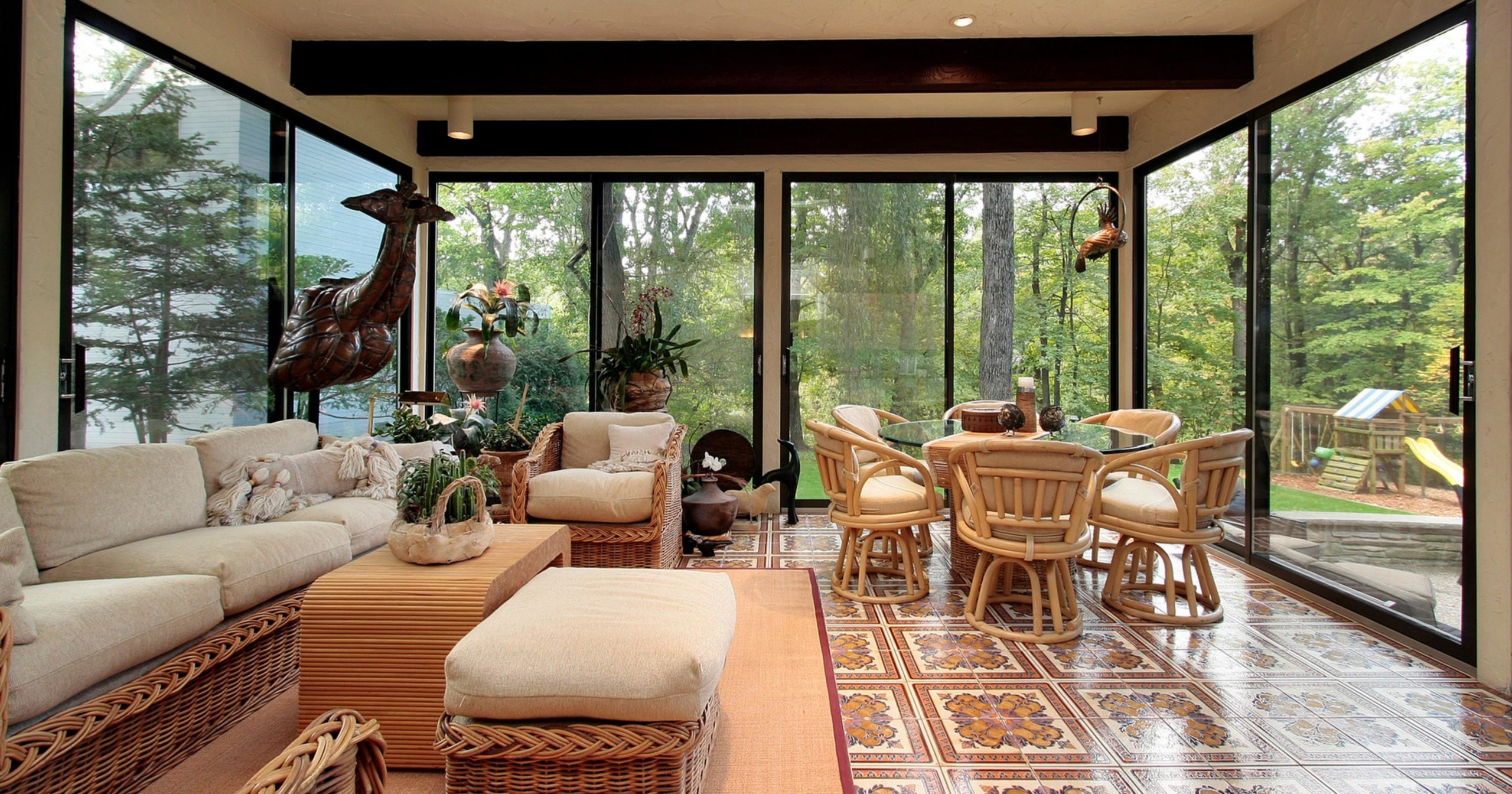
Its principal advantages are simplicity, reliability, and cost. Fewer mechanical components than lift-and-slide or tilt-and-slide systems means fewer points of potential failure and lower initial cost. For openings in the 6-to-10-foot width range where standard thermal performance is acceptable, a well-specified standard sliding patio door is a straightforward and durable solution.
Its principal limitation is airtightness. The sliding panel must maintain clearance between its bottom rail and the sill track at all times to slide freely. This clearance is bridged by a brush or pile weatherstrip that provides good but imperfect air sealing — adequate for most residential applications but not approaching the performance of a compression-sealed swinging or lift-and-slide door. In high-performance building envelopes where minimizing air infiltration is a design priority, the standard sliding configuration is not the optimal specification.
Standard sliding patio door sizing at MILLENNIUM® ranges from 6 feet wide by 6 feet 8 inches tall as a practical minimum to 12 feet wide by 10 feet tall in standard aluminum configurations. Panels beyond these dimensions require engineering review.
Lift-and-Slide Patio Doors
The lift-and-slide patio door is the performance evolution of the standard sliding door, and MILLENNIUM®’s recommended specification for most residential patio door applications. The operating principle differs from standard sliding in one critical respect: when the handle is turned to open, a cam mechanism lifts the panel clear of its perimeter weatherstrip seal and onto its roller carriages before the panel begins to travel. When the panel is returned to the closed position and the handle is turned to lock, the cam lowers the panel back into full compression against a continuous perimeter seal — top, bottom, and both sides — simultaneously engaging all locking points.
This lift-and-lower sequence produces two performance advantages that standard sliding cannot match.
Airtightness. When locked, the lift-and-slide panel is fully seated against a continuous elastomeric perimeter seal with no clearance anywhere. The result is air infiltration performance comparable to a high-quality casement window — substantially better than any standard sliding system regardless of weatherstrip quality. For energy-conscious buyers, this distinction is significant: the air infiltration difference between a standard sliding door and a quality lift-and-slide door in the same opening is often larger than the difference between double-pane and triple-pane glazing.
Effortless operation at large panel weights. A sliding panel measuring 5 feet wide by 9 feet tall in triple-pane glass weighs 500 pounds or more. Moving this panel while it drags against a bottom weatherstrip requires substantial force and causes accelerated wear on both the seal and the roller system. Lifted clear of its seal on precision roller carriages, the same panel moves with light, consistent effort from a single hand. Lift-and-slide makes very large panels practically operable that would otherwise be physically demanding and mechanically hard on the system.
Lift-and-slide sizing at MILLENNIUM® accommodates panels up to 16 feet wide by 10 feet tall in single-track configurations, and wider with multi-panel arrangements. Panel widths up to approximately 48 inches per individual panel are standard; wider individual panels require engineering review of the roller carriage specification.
Tilt-and-Slide Patio Doors
A tilt-and-slide door combines two operating modes in a single panel: it can slide horizontally in the standard manner for full opening and egress access, and it can tilt inward at the top — like a hopper window — for controlled ventilation without fully opening the panel.
The tilt function addresses one of the practical limitations of a sliding patio door as a ventilation device. A sliding door in its standard open position creates a large, unscreened opening that admits insects, wind, and rain along with fresh air, and requires a screen panel to manage these. The tilt function opens the top of the panel inward by a few inches — enough for meaningful air exchange but not enough to admit insects or significant wind-driven rain, and too narrow for any security concern. The tilted panel can be left in this position during light rain, during absences from the room, and overnight — conditions where leaving a panel fully open would be impractical.
The mechanical sequence of a tilt-and-slide is similar to a tilt-and-turn window: the handle position determines the operating mode. In one position, the panel is closed and locked. In a second position, the panel slides horizontally. In a third position, the top tilts inward. As with the tilt-and-turn window, the handle must be returned to the closed position before switching between slide and tilt modes to avoid placing stress on the linkage hardware.
The tilt-and-slide configuration typically accommodates somewhat smaller maximum panel dimensions than the lift-and-slide, because the dual-mode hardware adds mechanical complexity that places limits on the panel weight and dimensions the system can manage. For projects where both the ventilation function of the tilt mode and the large-format performance of the lift-and-slide are priorities, MILLENNIUM® will advise on the optimal configuration for the specific opening dimensions and performance objectives.
Panel Configurations
Beyond the operating mechanism, patio door systems are described by their panel count and arrangement — how many panels the total door width is divided into, and which are fixed versus operable.
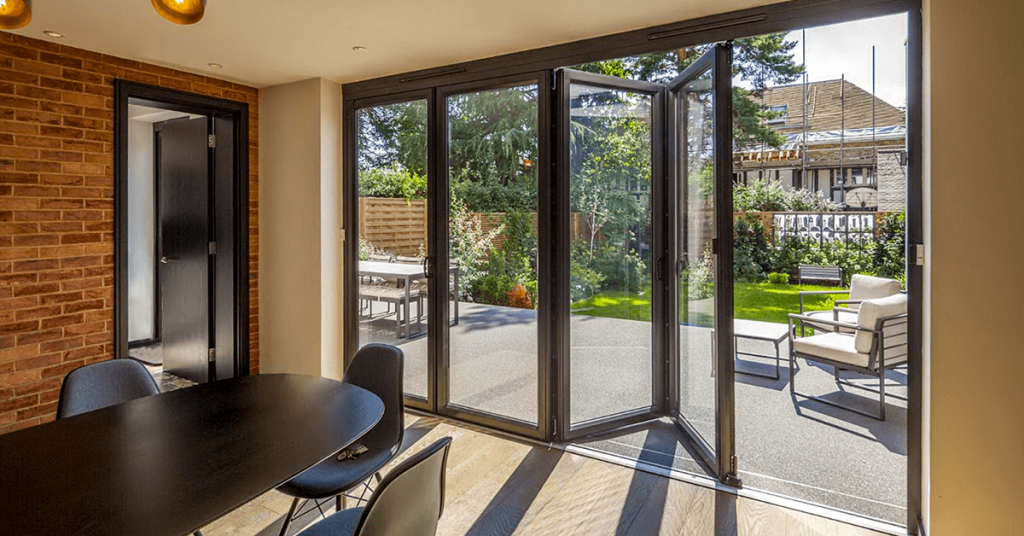
Two-panel (XO or OX) — One fixed panel and one sliding panel. The most common residential configuration. The clear opening is approximately half the total door width.
Three-panel (OXO or XXO) — Three panels, various combinations of fixed and sliding. OXO — sliding panels on each side of a fixed center panel — provides ventilation and access from both ends of the door while the fixed center panel provides the primary view. XXO — two sliding panels and one fixed outer panel — allows both operating panels to stack at one end, creating a clear opening approaching two-thirds of the total door width.
Four-panel (OXXO or XXOO) — Four panels configured for large openings of 12 to 20 feet. OXXO slides panels from each end toward the center fixed panels; XXOO stacks all operating panels at one side. The four-panel configuration addresses openings that exceed the practical range of a two-panel system.
The notation convention uses X for fixed panels and O for operable panels, reading left to right as viewed from the interior.
The Threshold: Critical Detail for Patio Doors
The sill threshold of a patio door is the detail that most directly affects day-to-day usability, long-term weather performance, and accessibility. It deserves more attention during specification than it typically receives.
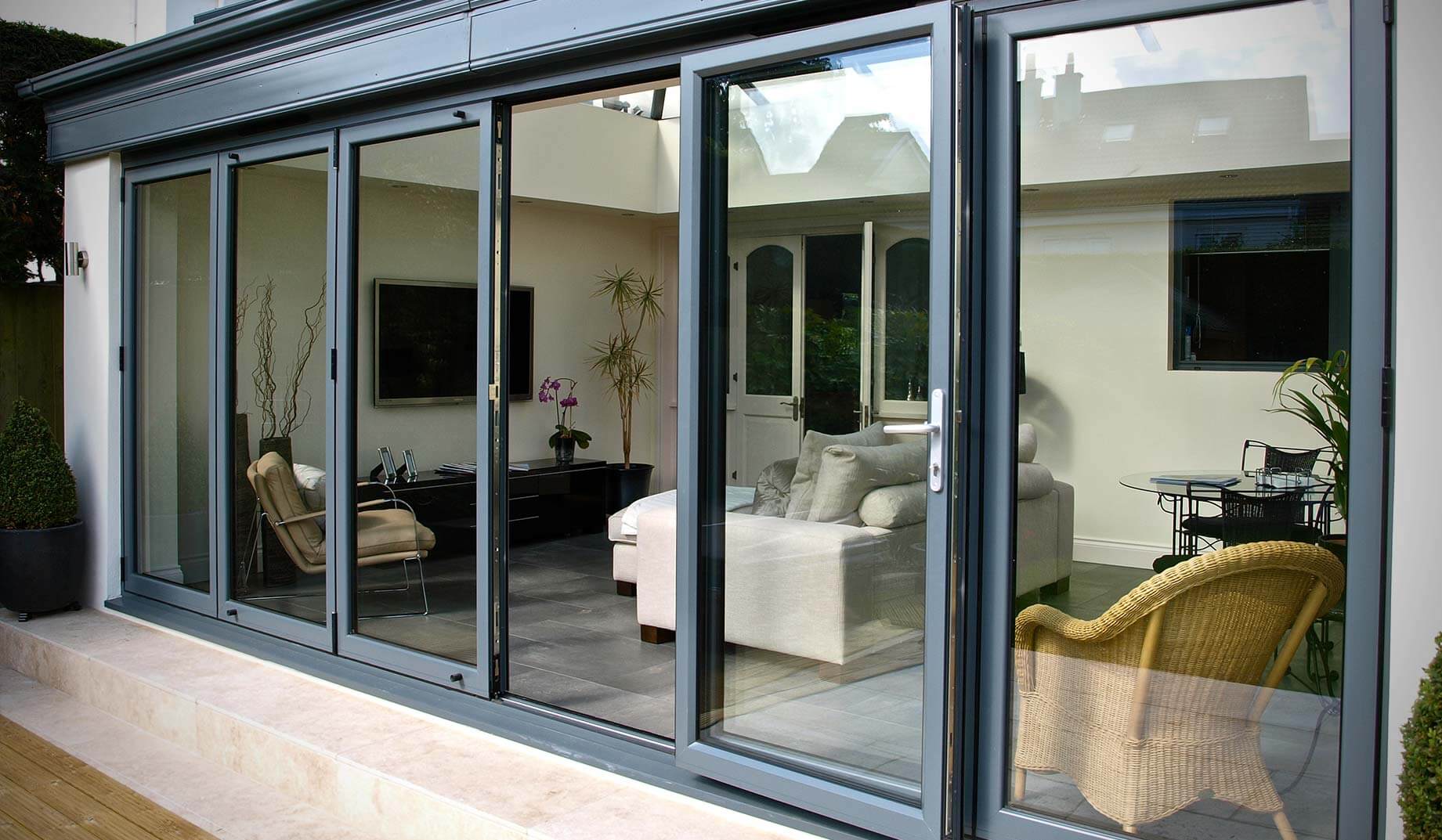
Flush thresholds — where the interior floor and exterior deck or patio surface meet with minimal height difference at the door sill — are the most desirable configuration for comfort, aesthetics, and accessibility. A true flush threshold requires careful waterproofing design: the track profile must drain any water that reaches the sill outward without allowing it to accumulate and overflow into the interior. Lift-and-slide systems, because their panel lifts clear of the sill during operation, accommodate lower-profile threshold designs more readily than standard sliding systems.
Low-profile thresholds that minimize the step height — typically 3/4 inch or less — are achievable in most patio door installations with appropriate sill design and waterproofing. These are strongly recommended for accessibility and for comfortable traffic flow between interior and exterior, particularly in households with children, elderly occupants, or anyone with mobility considerations.
Thermal performance at the threshold requires a thermal break in the sill profile. An aluminum sill without a thermal break becomes cold in winter — cold enough to cause condensation on the adjacent interior floor surface and to create a noticeable cold zone at floor level beside the door. MILLENNIUM® thermally broken sill profiles eliminate this condensation pathway.
Screen Options
A sliding patio door in its open position creates a large opening between interior and exterior. In warm-weather months when the door is frequently used for ventilation, insect screening is a practical necessity in most American climates.
Sliding screen panels travel on a separate track within the door frame, typically on the interior side of the door track, and slide independently of the door panel. They cover the clear opening when the door is open and retract to a parked position beside the fixed panel when the door is closed. Sliding screens are the standard solution for most residential patio door applications.
Retractable screens roll into a compact housing at one side of the opening when not in use, deploying across the opening when needed and retracting completely out of view otherwise. Retractable screens are appropriate for installations where a visible parked screen panel beside the door would be aesthetically objectionable, and for lift-and-slide and tilt-and-slide systems where the door track geometry does not accommodate a standard sliding screen.
Energy Performance
A patio door’s large glazing area makes glazing specification more consequential than for any smaller window in the same building. The orientation of the door determines the most important performance parameters.
South-facing patio doors in Oklahoma’s climate benefit from passive Low-E coatings that admit winter solar gain — contributing free heating on sunny winter days — while limiting summer overheating. A properly proportioned roof overhang above a south-facing patio door shades the glazing in summer when the sun is high, allowing the lower-angle winter sun to enter fully. This passive solar strategy is most effective when the patio door is part of a deliberate solar design — appropriate overhang depth, adequate thermal mass inside the glazing line, and correct glazing SHGC for the latitude.
West-facing patio doors receive intense late-afternoon summer sun at a low angle that a roof overhang cannot shade effectively. Solar control Low-E glazing with a Solar Heat Gain Coefficient of 0.25 to 0.30 is the appropriate specification for west-facing patio doors in Oklahoma’s climate, significantly reducing the cooling load and interior discomfort from afternoon sun without meaningfully reducing visible light transmittance.
North-facing patio doors receive no direct sun at any time of year and are purely a heat loss pathway in winter. The lowest available U-factor — triple-pane glazing — is worth specifying for north-facing patio door installations in mixed or cold climates, where the heat loss through the large glazed area is the dominant thermal impact.
MILLENNIUM® patio doors are glazed with double-pane Low-E insulating glass with argon gas fill, warm edge spacer bars, and butyl rubber perimeter seals as standard, achieving U-factors in the 0.25 to 0.35 range. Triple-pane is available as upgrade. Solar control or passive Low-E coating is selected by orientation at the time of specification.
Security
Multi-point locking is standard on all MILLENNIUM® patio doors, engaging the frame at the head, sill, and intermediate points simultaneously when the handle is turned to lock. Anti-lift pins set into the top rail of all sliding panels engage the overhead track channel and physically prevent the panel from being lifted out of its track from the exterior — addressing the primary forced-entry vulnerability of sliding door systems.
Laminated safety glass is standard on the interior pane of all MILLENNIUM® patio door panels. For higher security requirements, laminated glass on both panes, thicker interlayers, and ionoplast rather than PVB interlayers provide increasing forced-entry resistance. Ballistic-resistant glazing is available for the highest security applications.
MILLENNIUM® Patio Door Specifications
Frame — A-Series thermally broken aluminum. Full powder coat color palette, dual-tone finishes available.
Glass — Double-pane Low-E insulating glass with argon gas fill, warm edge spacer bars, and butyl rubber perimeter seals as standard. Tempered exterior pane, laminated interior pane. Solar control or passive Low-E by orientation. Triple-pane available as upgrade. Ballistic-resistant glazing available.
Hardware — Stainless steel roller carriages matched to panel weight. Multi-point locking. Anti-lift pins standard on all sliding configurations. Lift cam mechanism on lift-and-slide units. Dual-mode handle and linkage on tilt-and-slide units. Motorized operation available on lift-and-slide configurations.
Sizing — Standard sliding: 6 to 12 feet wide, to 10 feet tall. Lift-and-slide: to 16 feet wide in single-track configurations, to 10 feet tall, larger with engineering review. Tilt-and-slide: to 12 feet wide by 9 feet tall standard.
Frame Series — A-Series thermally broken aluminum is the standard specification for all patio door configurations. M-Series aluminum-exterior / wood-interior available for projects where interior wood surfaces are a design priority.
Contact MILLENNIUM® Windows and Doors for a free consultation and appraisal. Our team will evaluate your opening dimensions, orientation, performance objectives, and spatial conditions and recommend the patio door configuration and specification that best serves your project.
Phone: 918-582-5025