A Wall That Opens Completely.
Every other door type creates an opening within a wall. A bi-fold glass door system eliminates the wall. When fully open, a bi-fold system folds its panels compactly to one or both sides of the opening, leaving a clear span of glass-free space that connects interior and exterior as directly and completely as the building structure allows. No panel remains in the opening. No threshold interrupts the floor plane more than necessary. The room and the terrace, the kitchen and the garden, the living space and the deck become, for practical purposes, one continuous space.
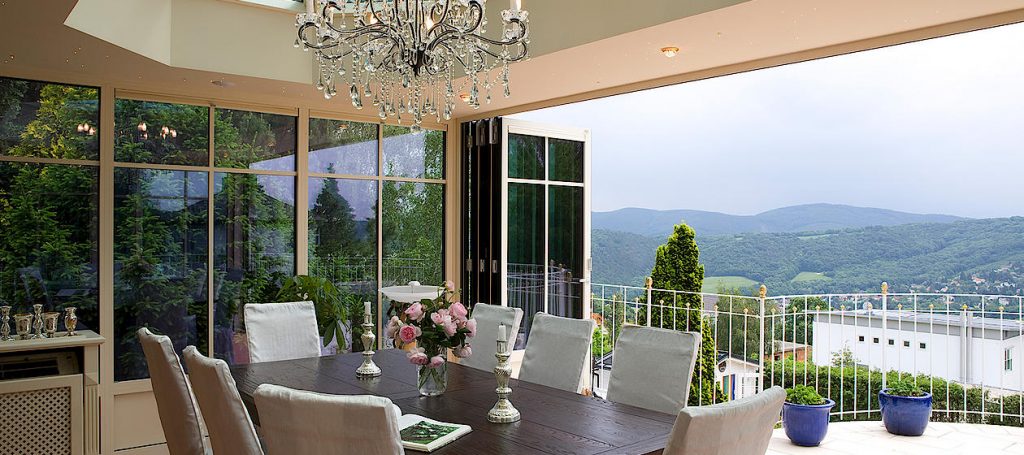
This is not a marginal improvement over a sliding door or a pair of French doors. It is a qualitatively different experience of indoor-outdoor living — one that changes how a room is used, how it feels, and how the house relates to its site. It is why bi-fold glass wall systems have become the defining architectural detail of high-quality indoor-outdoor residential design.
MILLENNIUM® bi-fold glass door systems are custom engineered for each opening in the A-Series thermally broken aluminum frame, in configurations from three to seven panels, with single or double track systems, and with the full range of glazing specifications described below.
How a Bi-Fold System Works
Each panel in a bi-fold system is hinged to its adjacent panel along one vertical edge, and carries a precision roller carriage on its top edge that travels along an overhead track. The panels fold in pairs — each pair consists of two panels hinged together that fold against each other as they travel along the track, halving their combined width as they stack. Multiple folding pairs stack progressively against the opening edge, compressing the full wall of glass into a compact accordion of panels at one or both sides of the opening.
The track carries the load. In a quality bi-fold system, the overhead track bears the full structural weight of all panels through their roller carriages. The floor track — present in most configurations — serves only as a guide that keeps the bottom of each panel aligned and prevents lateral movement under wind load. It does not carry panel weight. This load distribution allows the floor track to be as shallow and flush as the weather sealing requirements of the installation permit, minimizing the threshold step and creating the smoothest possible floor transition between interior and exterior.
Operation is one continuous motion. The first panel is unlatched and pushed or pulled; the connected panels follow in sequence, folding against each other and traveling along the track until all panels are stacked at the opening edge. There is no panel-by-panel sequencing required. The entire wall opens in a single sweep that takes seconds. The precision roller carriages that make this smooth operation possible are stainless steel, sealed against debris and moisture, and rated for hundreds of thousands of operating cycles.
Single Track vs. Double Track Systems
Single track systems carry all panels on one overhead track, with all panels folding and stacking to one side of the opening. This is the simpler and more common configuration. It requires clear wall space at one side of the opening sufficient to accommodate the stacked panel depth — typically 4 to 6 inches of stack depth per panel, so a five-panel system requires 20 to 30 inches of clear space at the stack side. The clear opening created is the full width of the opening minus the stack width.
Double track systems split the panels to fold and stack toward both sides of the opening simultaneously — typically an even number of panels, half traveling to each side. This configuration requires clear wall space at both sides but creates a larger clear opening relative to the total wall width because the stack is divided between two sides rather than concentrated at one. A six-panel double track system creates a clear opening approaching the full wall width, with only the two end stacks reducing the opening at each side. Double track systems also provide better structural performance under wind load because the panel array is anchored at both ends when open.
For the most demanding applications — wide openings, high wind exposure, maximum clear opening width — MILLENNIUM® double track systems provide both the structural performance and the open span that single track systems cannot match at the same overall dimensions.
Panel Count and Configuration
The number of panels in a bi-fold system determines the relationship between the total opening width, the individual panel width, the stack depth, and the clear opening achieved. These relationships are interdependent and must be balanced against the structural constraints of the opening and the aesthetic objectives of the project.
Three-panel systems are the minimum practical bi-fold configuration. Two panels fold against a third fixed or operable end panel, stacking at one side. Appropriate for openings of 6 to 10 feet in width. The end panel can be a traffic door — a panel that opens independently as a standard hinged door for everyday passage without opening the full system — which is a valuable feature for bi-fold systems used in frequently trafficked locations.
Four-panel systems fold two-and-two to each side in a double track configuration, or all four to one side in a single track configuration. Appropriate for openings of 8 to 14 feet. The four-panel double track configuration is one of the most balanced and commonly specified bi-fold arrangements for residential living room and kitchen terrace applications.
Five and six-panel systems address wider openings of 12 to 20 feet and are among the most architecturally dramatic configurations available. A six-panel system folding three-and-three to each side creates a clear opening approaching the full width of the wall — the interior and exterior spaces become contiguous across a span that reads as a complete architectural opening rather than simply a large door.
Seven-panel systems are appropriate for very wide openings in residential great rooms, commercial applications, and hospitality settings where the full wall opening is the primary design intent. At this panel count, structural engineering of the overhead track system and the support structure above the opening is critical — the combined weight of seven full-height glass panels is substantial and the header above the opening must be designed accordingly.
The Traffic Door
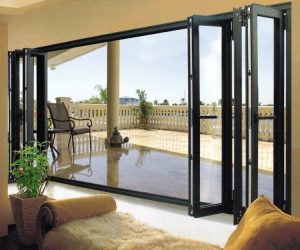
Any panel in a bi-fold system can be specified as a traffic door — a panel that is hinged and latched independently of the folding system and can be opened as a standard single door without actuating the full bi-fold mechanism. The traffic door is typically the end panel closest to the interior — the panel at the stack side in a single track system, or one of the two end panels in a double track system.
The traffic door addresses one of the practical limitations of a bi-fold system as a primary exterior door: opening the full system for everyday passage — to step outside briefly, to bring in a delivery, to let the dog out — is unnecessary and inefficient. The traffic door provides a standard single-door opening in the same frame for everyday use, with the full bi-fold capability available when the complete opening is needed.
MILLENNIUM® recommends specifying a traffic door in any bi-fold system that will be used as a primary or frequently used exterior access point. Where the bi-fold system is used exclusively for indoor-outdoor living events — parties, warm-weather entertaining, seasonal opening of the living space — a traffic door may be less necessary.
Inward vs. Outward Folding
Bi-fold panels can be configured to fold inward — into the interior space — or outward — onto the exterior terrace or deck.
Outward folding is generally preferred for exterior applications because the panels, when open and stacked outside, do not reduce the interior floor area. The stack sits on the exterior side of the threshold, leaving the full interior floor space available. The stacked panels do require clear exterior wall space and must be protected from wind — an outward-folding system in an exposed location must have the stacked panels secured against wind load, which quality bi-fold hardware accommodates through panel retention clips or magnetic catches at the stack position.
Inward folding is appropriate where exterior clearance at the stack side is limited — a flush deck edge, a planter, an adjacent wall — or where the interior stack position is architecturally acceptable. Inward folding panels, when stacked, project into the interior room by the stack depth and must be clear of furniture, circulation paths, and interior wall features.
MILLENNIUM® evaluates the exterior conditions, interior layout, and structural constraints of each installation and recommends the folding direction that best serves the specific project.
Glazing Specification
The glazing in a bi-fold system is subject to more demanding structural and thermal conditions than a standard window or door. The panels are large — typically 3 to 4 feet wide and 7 to 10 feet tall in residential applications — and the glass unit must withstand wind load, thermal cycling, and the mechanical stresses of repeated folding operation without seal failure or glass breakage.
Standard — Double-pane Low-E insulating glass with argon gas fill, warm edge spacer bars, and butyl rubber perimeter seals. Tempered glass on both panes — a code requirement for glazing in door panels and strongly recommended for the mechanical demands of bi-fold operation. Tempered glass is approximately four times stronger than annealed glass of equivalent thickness and, when broken, fractures into small blunt fragments rather than large dangerous shards.
Solar control — For south and west-facing bi-fold installations, solar control Low-E coatings with a lower SHGC limit solar heat gain through the large glazed area. A six-panel bi-fold system facing west presents a very large solar aperture in late afternoon summer conditions — appropriate glazing specification is essential to prevent overheating of the interior space.
Acoustic — Asymmetric pane thicknesses — different glass thicknesses on each pane of the insulating unit — avoid the acoustic coincidence effect that causes a resonance dip in sound transmission loss at specific frequencies, providing more consistent acoustic performance across the full frequency range. Relevant for bi-fold installations in acoustically sensitive locations adjacent to traffic, mechanical equipment, or other significant noise sources.
Laminated — Laminated safety glass with PVB or ionoplast interlayer is available and recommended for bi-fold installations at grade level where security is a concern, and for any installation where the glass area and accessibility create a forced-entry exposure that standard tempered glass does not adequately address.
Triple-pane — Available as an upgrade for maximum thermal performance. The additional weight of triple-pane glass in a large bi-fold panel is a factor that affects both the hardware specification and the structural design of the overhead track — MILLENNIUM® accounts for this in the hardware and structural coordination for every triple-pane bi-fold project.
Thermal and Weather Performance
A bi-fold system’s weathertightness depends on three elements: the perimeter seal between the frame and the rough opening, the compression weatherstrip on each panel that seals against adjacent panels and the frame when closed, and the threshold seal at the sill.
The perimeter seal and the panel weatherstrip perform similarly to any high-quality door system. The threshold is the most demanding detail. A bi-fold threshold must seal against wind-driven rain, accommodate the travel of the panel roller carriages along the floor track, and present as low a step height as possible for comfort and accessibility. MILLENNIUM® bi-fold thresholds use a multi-chamber aluminum sill profile with a thermally broken cross-section, an integrated drainage channel that manages any water that reaches the sill, and a compression weatherstrip on the bottom rail of each panel that engages the sill surface when the system is closed and locked.
The A-Series thermally broken aluminum frame ensures that the frame profiles themselves do not become thermal bridges between the exterior and interior. The polyamide thermal break in each frame and panel profile eliminates the conductive heat loss pathway through the aluminum that would otherwise make a large aluminum bi-fold system a significant thermal liability in cold weather.
Structural Requirements
A bi-fold opening of meaningful width — eight feet or more — is a large penetration in the building envelope that must be structurally accounted for at the design stage. The wall above the bi-fold opening must be carried by a structural header or beam of sufficient span and depth, engineered for the specific load conditions of the building. In load-bearing exterior walls, this is a significant structural element that must be designed by a structural engineer and installed as part of the construction work preceding the door installation.
MILLENNIUM® coordinates all required structural engineering for bi-fold door installations, working with the project’s structural engineer or providing structural engineering coordination as part of the complete installation scope. The overhead track system that carries the bi-fold panels must be anchored to the structural header above — not to finish framing or drywall — and the anchor detail must be specified for the combined weight and wind load of the full panel system.
Applications
Residential living rooms and great rooms opening to rear terraces — the primary application. A living room bi-fold wall creates an indoor-outdoor living space that functions as one room in warm weather and two rooms in cold weather, with the transition between them taking seconds.
Kitchen and dining rooms opening to outdoor dining areas — bi-fold doors between a kitchen or dining room and an outdoor dining terrace create a seamless indoor-outdoor entertaining configuration that no other door type can match for openness and convenience.
Master suite to private terrace or balcony — a bi-fold wall between a bedroom and a private outdoor space creates a suite configuration with the generosity of a resort setting.
Commercial and hospitality applications — restaurants opening to outdoor seating, hotel rooms opening to terraces, retail spaces opening to street frontage. At commercial scale, bi-fold systems are specified with heavier hardware, wider panels, and higher wind resistance ratings than residential systems.
MILLENNIUM® Bi-Fold Specifications
Frame — A-Series thermally broken aluminum. Extruded profiles engineered for the structural and operational demands of multi-panel bi-fold systems. Full MILLENNIUM® powder coat color palette, dual-tone available.
Hardware — Stainless steel precision roller carriages rated for the panel weight and operating cycle requirements of the installation. Concealed multi-point locking on the closure panel engaging the frame at head and sill. Panel retention clips at the stack position for outward-folding systems in exposed locations. Traffic door hinges and locking hardware where specified.
Track — Single or double overhead track in extruded aluminum, anchored to the structural header above the opening. Shallow aluminum floor guide track. Track profiles selected for panel weight, panel count, and wind load conditions of the installation.
Panel dimensions — Individual panel widths typically 24 to 48 inches. Panel heights to 120 inches as standard; greater heights available with engineering review. Minimum three panels; maximum seven panels in standard residential configurations.
Contact MILLENNIUM® Windows and Doors for a free consultation and appraisal. Bi-fold door projects require careful coordination of panel count, folding direction, structural header, threshold detail, and glazing specification — our team will work through all of these with you from the initial design through completed installation.
Phone: 918-582-5025