What Is a Casement Window?
A casement window is a sash that is attached to its frame by one or more hinges along one vertical side and operated by a crank mechanism, handle, or push bar. When opened, the sash swings outward — or in some configurations, inward — on a horizontal plane, much like a door. This side-hinged, crank-operated design gives the casement window two defining characteristics that set it apart from every other window type: the best airtightness of any operable window style, and the ability to open to a full 90°, delivering maximum unobstructed ventilation.
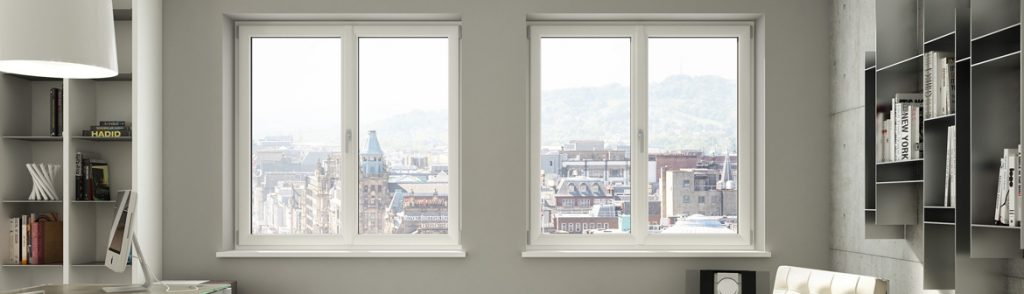
Casement windows have been in use for centuries and remain one of the most versatile and widely specified window types in residential and commercial construction. Their clean sightlines, excellent thermal and acoustic performance, and flexible design compatibility make them a strong choice for virtually any application — from traditional craftsman homes to contemporary architecture.
How Casement Windows Work
The defining mechanical feature of a casement window is its compression seal. When the window is closed and the handle or crank is engaged, the sash is drawn tightly against a continuous weatherstrip running around all four sides of the frame, compressing it uniformly and creating a seal with no gaps. This four-sided compression seal is the reason casement windows achieve better airtightness than any sliding, hung, or tilt-turn window — all of which have movable sash joints that prevent a truly continuous perimeter seal.
The crank or handle mechanism serves two functions: it drives the sash outward to the desired open position and, when returned to the closed position, draws the sash back into the frame and compresses the seal. Multi-point locking mechanisms — standard on MILLENNIUM® casement windows — engage locking points at multiple positions along the sash perimeter simultaneously when the handle is turned, providing both security and uniform compression of the weatherstrip across the full height of the sash.
Outward-Opening vs. Inward-Opening Casements
Outward-Opening (the Standard) The great majority of casement windows are outward-opening. The sash swings to the exterior on side hinges, driven by an interior crank mechanism. This is the default configuration in North American residential construction and is available in the full range of frame materials. Outward-opening casements can be oriented to hinge on the left or the right side depending on the desired direction of opening and the location of prevailing breezes.
One practical consideration with outward-opening casements is exterior clearance: the sash swings outward and must have unobstructed space to open — no planters, air conditioning units, shutters, or foot traffic pathways directly in the swing path. For windows above walkways or patios, awning windows (which hinge at the top and swing outward at the bottom, keeping the opening above head height) are often a more practical alternative.
Inward-Opening Inward-opening casement windows hinge on the side and swing into the room rather than outward. This configuration is common in European architecture — the tilt-and-turn window, which MILLENNIUM® offers in the A-Series, is a sophisticated evolution of the inward-opening casement that adds a separate tilt function. Inward-opening casements eliminate the exterior clearance concern and make it easy to clean both the interior and exterior glass surfaces from inside the room. The trade-off is that an open inward-swinging sash occupies interior space and can interfere with window treatments, furniture, or traffic flow if the room layout is not planned accordingly. Frame material options for inward-opening configurations in the MILLENNIUM® line are aluminum (A-Series) and wood (W-Series).
Single-Sash vs. Double-Sash (1-Leaf vs. 2-Leaf)
Single-Sash (1-Leaf) Casement A single casement consists of one sash hinged on one side, covering the full opening. It is the simplest and most common configuration, available in any size from a narrow bathroom window to a large picture-style opening with a single uninterrupted pane of glass. Single casements work well in openings up to approximately 24–36 inches wide; beyond this width, the sash becomes heavy and the hardware must work harder to support and seal it.
Double-Sash (2-Leaf) Casement A double or French casement uses two sashes that meet in the center of the opening with no center post or mullion. Both sashes hinge outward (or inward) from the sides, and when fully open the entire width of the opening is unobstructed — a maximally open and airy configuration that is visually striking and provides the best possible uninterrupted view and ventilation of any casement arrangement. French casements are particularly popular in living rooms, bedrooms, and any room where a direct connection to an outdoor space — a deck, balcony, terrace, or garden — is desired.
For wider openings where a center post is acceptable, a double casement with a fixed mullion between two independently operable sashes is also available. This configuration provides structural rigidity at larger widths while retaining full operability of both sashes.
Key Advantages of Casement Windows
Best Airtightness of Any Operable Window Style The four-sided compression seal of a closed casement window provides the lowest air leakage rate of any operable window configuration. This directly translates to better thermal performance in cold and mixed climates, better acoustic isolation from exterior noise, and lower infiltration of dust, allergens, and humidity. For ENERGY STAR compliance and high-performance building applications, casement windows are the preferred operable window choice wherever ventilation requirements allow.
Maximum Ventilation — Full Sash Opening When a casement sash opens to 90°, the full area of the sash is available for airflow — nothing is obstructed. A 30″ × 48″ casement window open fully provides 10 square feet of unobstructed ventilation opening. A double-hung window of the same size can provide at most half that area, since only one sash moves at a time and the sash itself blocks part of the opening. For rooms where cross-ventilation and air quality are priorities — bedrooms, kitchens, home offices — casement windows deliver meaningfully better airflow performance.
Additionally, the outward-swinging sash of an exterior casement acts as a scoop when oriented to catch prevailing breezes, channeling moving air into the room even when the breeze is not perpendicular to the window. This effect can significantly increase natural ventilation effectiveness in warm weather.
Unobstructed Views and Sightlines Because a casement window has no horizontal meeting rail dividing the sash — unlike any hung window — and typically no center mullion on a single-sash unit, it provides the clearest, most unobstructed view of any operable window of equivalent size. The absence of a center horizontal bar is particularly noticeable in landscape views and water views, where an unbroken sightline makes a significant difference in the quality of the visual connection to the exterior.
Ease of Operation The crank mechanism of a casement window requires minimal force to operate — far less than lifting a heavy double-hung sash or sliding a large sliding window panel. This makes casement windows particularly well suited for locations that are difficult to reach — over a kitchen counter, over built-in cabinetry, at the back of a deep window sill — and for occupants for whom lifting or pushing a heavy sash is physically challenging.
Easy Interior Cleaning The outward-swinging sash of an exterior casement allows both the interior and exterior glass surfaces to be cleaned from inside the room. When the sash is fully open, the exterior glass faces inward and is fully accessible without any tools, ladders, or exterior access. This is a significant practical advantage on upper floors and in any location where exterior access to the window glass is inconvenient.
Honest Considerations: Where Casement Windows Have Trade-Offs
Exterior Clearance Required Outward-opening casements require unobstructed exterior space in the swing path. This limits their suitability above walkways, patios, or in any location where the sash could obstruct a passage or be damaged. In these situations, awning windows or fixed windows are better alternatives.
Screen Placement Because the crank and hardware of an outward-opening casement are on the interior, the insect screen must be placed on the exterior of the window — behind the sash when it is open. This means the screen is more exposed to weather and physical damage than the interior-mounted screens of hung windows, and it must be removed or left in place when the sash opens (the screen stays fixed; the sash opens past it). This is a manageable trade-off but worth understanding before specifying.
Width Limitations on Single Sash A single casement sash beyond approximately 36 inches in width becomes mechanically demanding on the hardware and can develop sag over time. For wider openings, a double casement (2-leaf) or a casement-plus-fixed combination is the appropriate solution. MILLENNIUM® will advise on appropriate sash widths for each configuration during the design consultation.
Casement Window Combinations and Configurations
Casement windows combine naturally with fixed panels to create larger, more complex window compositions. Common and effective configurations include:
Casement + Fixed Sidelight(s) — A casement flanked by one or two fixed panels on either side creates a wide window composition with the visual presence of a large opening while the casement provides ventilation. The fixed panels can be divided with grilles or left clear depending on the desired aesthetic.
Casement + Fixed Transom — A fixed rectangular or arched transom above a casement sash adds height, light, and architectural interest to the window assembly. Transom configurations are particularly effective in rooms with high ceilings.
Picture Window + Flanking Casements — A large fixed picture window centered in an opening flanked by narrower operating casement panels on each side creates a classic composition that combines maximum view and light from the center with ventilation from the sides. This arrangement is common in living rooms and master bedrooms.
French Casement (Double No-Post) — As described above, two sashes opening from a shared center line with no mullion between them, providing a completely open, unobstructed view and maximum airflow.
Acoustic Performance and Asymmetric Glazing
For applications in high-noise environments — busy roads, flight paths, commercial districts, rail corridors — the superior airtightness of a casement window is a meaningful starting point for acoustic isolation. Sound intrusion through windows occurs through two pathways: transmission through the glass itself, and infiltration through gaps and weatherstrip joints. The casement’s compression seal addresses the second pathway better than any other operable window type.
For the glass itself, asymmetric double glazing is the most effective upgrade for acoustic performance. In an asymmetric unit, the two glass panes are of different thicknesses — for example, one 6mm pane paired with one 8mm or 10mm pane. Because glass of different thicknesses resonates at different frequencies, the asymmetric combination avoids the coincidence effect where both panes resonate together at the same frequency, resulting in meaningfully better sound attenuation across the frequency range compared to a symmetric unit with two panes of equal thickness. Laminated glass on the exterior pane adds a further acoustic benefit through the viscoelastic PVB interlayer, which absorbs vibrational energy. MILLENNIUM® can specify asymmetric and laminated glazing configurations for any casement window application where sound reduction is a priority.
MILLENNIUM® Frame Series
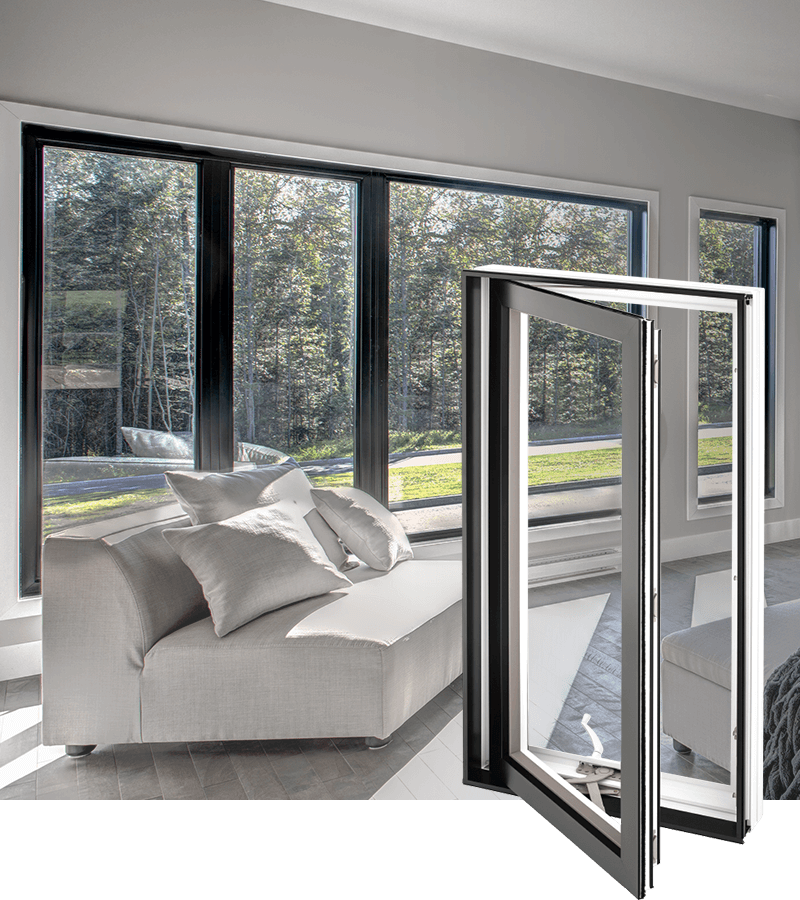
A-Series — Thermally Broken Aluminum All-aluminum frame with a polyamide thermal break separating the interior and exterior profiles. Maximum dimensional stability, corrosion resistance, and structural rigidity. Available in both outward- and inward-opening configurations. Ideal for contemporary architecture, commercial applications, and any project where low maintenance and long-term frame integrity are paramount.
M-Series — Aluminum Exterior / Wood Interior Weather-resistant aluminum exterior cladding with a natural wood interior surface. The combination eliminates exterior maintenance while preserving the warmth and design flexibility of wood inside. Available in outward-opening configuration.
W-Series — Solid Wood / Aluminum Exterior Cladding A solid wood frame providing natural thermal insulation and the most favorable environmental life-cycle profile of any frame material, protected externally by aluminum cladding. The choice for craftsman, traditional, and period residential architecture where genuine wood craftsmanship is integral to the design intent. Available in outward- and inward-opening configurations.
Glass Specifications
All MILLENNIUM® casement windows include double-pane Low-E insulating glass as standard, with argon gas fill, warm edge spacer bars, and butyl rubber perimeter seals. The Low-E metallic coating — microscopically thin, optically transparent layers of silver oxide applied to the interior-facing glass surface — reduces the glass emissivity to as low as 0.02–0.04, limiting heat transfer through the glazing while maintaining high visible light transmittance.
Optional upgrades include triple-pane glazing for maximum thermal and acoustic performance, asymmetric and laminated glazing for acoustic applications, tempered glass where required by code, and ballistic-resistant glazing for security installations.
Contact MILLENNIUM® Windows and Doors for a free consultation and appraisal. Our team will guide you through sash configuration, hinge orientation, frame series, glazing specification, and hardware selection to design the right casement window for every opening in your project.
Phone: 918-582-5025