What Is a Skylight Window?
A skylight window is a glazed opening installed in a roof or ceiling plane rather than a vertical wall, admitting natural light — and in operable configurations, fresh air — directly from above. Because skylights face the sky rather than a wall or adjacent structure, they capture light for a longer portion of the day and from a wider arc of the sky than any vertical window of equivalent size. A skylight measuring two feet by four feet can deliver more useful daylight to an interior space than a vertical window several times larger in the same room.
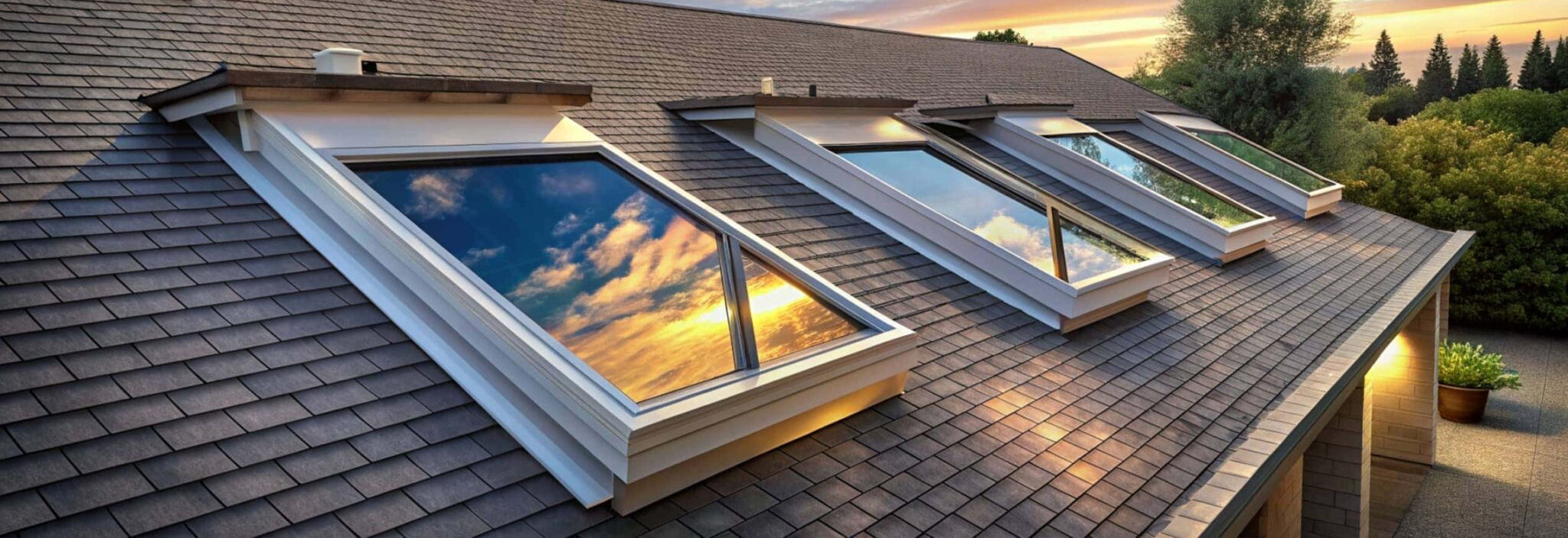
Skylights serve two distinct purposes depending on their type and position in the roof: daylighting, which improves the quality and quantity of natural light in interior spaces; and ventilation, which allows warm air, moisture, and stale air to exhaust through the roof plane — the highest and most effective point in a building for natural stack-effect ventilation. Many skylight types serve both functions simultaneously.
MILLENNIUM® custom designs and installs skylight windows for residential, commercial, and institutional applications across pitched roofs, flat roofs, and roof terraces, in fixed and operable configurations, in the A-Series thermally broken aluminum frame.
Why Natural Light From Above Is Different
Light entering through a vertical wall window is directional — it illuminates the portion of the room closest to the window most strongly and falls off rapidly with distance from the glass. Rooms lit only by vertical windows have bright zones near the glass and darker zones further in, a contrast that is visually uncomfortable and often requires supplemental artificial lighting even during daylight hours.
Light entering through a skylight is more diffuse and more evenly distributed. It reaches the ceiling first and scatters downward across the entire floor area of the room, producing a more uniform luminous environment with significantly less contrast between bright and dark zones. This quality of light — even, overhead, and changing naturally through the day as the sun moves — is widely recognized as the most comfortable and flattering natural light available in any interior environment, and it is the reason skylights are the preferred daylighting strategy in galleries, museums, studios, and high-quality residential spaces.
Skylights also deliver light at the times and angles that vertical windows cannot. A north-facing room that receives little direct sun through its walls throughout the day still receives consistent, even, cool-toned daylight through a roof skylight. A room blocked on all four sides by adjacent buildings or landscaping can receive abundant natural light through its roof when no vertical window option is viable.
Types of Skylight Windows: Pitched Roof Applications
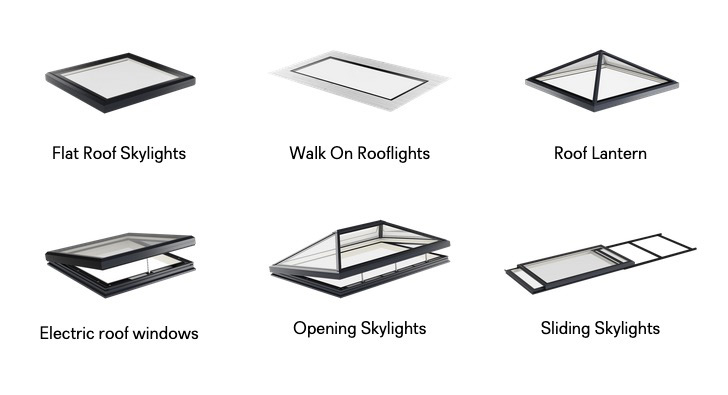
Fixed Flat-Pane Skylight The most common and most affordable skylight type. A rectangular or square framed opening in the pitched roof plane, glazed with a flat insulating glass unit. Fixed skylights admit light but do not ventilate. They are the appropriate choice where daylighting is the sole objective and where the roof plane construction makes an operable skylight mechanically impractical. Fixed skylights are also the preferred specification wherever maximum thermal performance is the priority, since the sealed fixed unit has no movable weatherstrip joints that could develop air infiltration over time.
Operable Venting Skylight An operable skylight opens to provide both light and ventilation. The sash typically hinges at the top of the frame and opens by pivoting outward at the bottom — an awning configuration when viewed from outside, with the bottom of the glass lifting away from the roof plane. Operable skylights are essential in kitchens, bathrooms, and attic spaces where moisture, heat, and airborne pollutants accumulate near the ceiling and must be exhausted. Because the opening is at the highest point in the room, the buoyancy of warm, moist air drives it naturally toward and through the skylight — no mechanical fan required. A venting skylight in a kitchen above or near the cooking area is one of the most effective passive ventilation strategies available.
MILLENNIUM® operable skylights are available with manual operation via a hand crank or extension pole, and with electric motorized operation for skylights positioned out of comfortable reach. Motorized units can include rain sensors that automatically close the skylight when precipitation is detected.
Roof Window A roof window is a full-size window installed flush within the pitched roof plane, typically at a lower pitch angle and lower installation height that allows it to serve as both a skylight and a conventional window — providing light, views, ventilation, and in some configurations, emergency egress access. Roof windows are most commonly installed in habitable attic rooms, dormer bedrooms, and loft conversions where the sloped ceiling follows the roof pitch and a conventional vertical window is not available or practical.
Roof windows are available in several operating configurations:
Top-hung — The sash pivots from the top edge, swinging outward at the bottom. Provides good ventilation and easy operation, and can be used as an egress exit when sized to meet IRC minimum clear opening dimensions.
Centre-pivot (rotating) — The sash pivots on a horizontal axis at mid-height, rotating 180° so the exterior glass face turns inward for easy cleaning from inside the room. The most common roof window operating type in European residential construction. Excellent for upper-floor rooms where exterior roof access for glass cleaning is impractical or dangerous.
Bottom-hung — The sash pivots from the bottom, opening inward at the top. Provides controlled ventilation and good rain protection but a more limited opening angle than top-hung or centre-pivot types.
Projection-opening — The sash projects outward from the bottom while the top of the sash rises above the roofline, creating a small protected opening that admits both light and rain-protected fresh air. Particularly effective for sleeping rooms where overnight ventilation without weather exposure is desired.
Balcony Roof Window — A specialized large-format roof window in which the lower sash folds outward to form a railing-protected balcony platform, effectively creating a temporary outdoor space from an upper-floor room that has no conventional balcony access. The balcony roof window is primarily a European product and represents the most ambitious and architecturally dramatic roof window configuration available.
Arched Roof Window A roof window with an arched upper profile — semicircular, elliptical, or segmental — that adds architectural character to the installation. Arched roof windows are particularly effective in attic rooms with high peak ceilings, in stairwells where the angled geometry of the roof creates a natural location for an arched feature window, and in heritage or period renovation projects where an arched profile matches existing architectural details.
Heritage / Vertical Mullion Roof Window A roof window divided by vertical mullions into two, three, or more equal-width panes within a single frame. The multi-pane composition creates a traditional appearance that suits historic and period architectural styles, and provides additional structural rigidity for larger openings. Heritage roof windows are commonly specified in Victorian, craftsman, and Arts and Crafts renovation projects.
Types of Skylight Windows: Flat Roof Applications
Flat and low-pitched roofs present different skylight challenges than pitched roofs. The shallow angle of the roof surface means that a standard pitched-roof skylight would sit nearly horizontal, making it vulnerable to standing water, debris accumulation, and the increased heat gain that comes with direct overhead sun exposure. Flat roof skylights use specific geometries and frame designs that address these challenges.
Flat Roof Skylight (Upstand-Mounted) The standard flat roof skylight sits on a raised upstand — a vertical curb projecting above the roof membrane — that lifts the glazed unit above the flat roof surface, allowing water and debris to drain off the surrounding roof membrane without accumulating against the frame. The glazing is typically pitched at a minimum angle of 5° to 15° to shed water. Upstand-mounted flat roof skylights are available in fixed and operable configurations, in rectangular, square, and custom plan geometries.
Pyramid Skylight A skylight with four triangular glazed faces rising to a central apex — a pyramid profile. Pyramid skylights are most commonly used on flat or low-pitched roofs where a central architectural feature is desired, and in commercial applications — atriums, lobbies, retail spaces, and circulation areas — where the pyramid form creates a dramatic focal point. The four-faced geometry ensures that water sheds efficiently from all sides without relying on a specific orientation, and the central ridge detail is the primary waterproofing challenge requiring careful design and maintenance attention.
Dome Skylight A dome skylight uses a curved acrylic or polycarbonate glazing panel — typically a prefabricated double-skin dome — rather than flat glass. The curved form is inherently self-draining and self-cleaning in rain, and the double-skin construction provides reasonable thermal insulation. Dome skylights are widely used in commercial and utility applications where their durability, light weight, and low maintenance are valued, and in residential applications where a rounded profile suits the architectural character of the building.
Modular Canopy (Glazed Roof) A modular glazed canopy is a flat or low-pitched glazed roof structure spanning an opening between walls — a covered courtyard, a conservatory roof, a link between two building elements, or a pergola replacement. Modular canopy systems use a grid of aluminum structural members to support individual double or triple-pane glass units across the full span of the opening. The result is a fully weather-protected, thermally insulated glazed roof that admits abundant natural light while providing complete shelter. Modular canopies are available in fixed glazing, with operable venting panels, and in sliding or retractable configurations for roof terrace applications.
Corner Canopy A glazed canopy configured to span a corner of the building — typically an L-shaped plan — requiring glazing panels on two planes meeting at a corner ridge. Corner canopies are common in residential conservatories and commercial entrance canopies where shelter is needed across a corner transition. The corner ridge detail is the most complex waterproofing element and requires precision fabrication and careful installation.
Smoke and Heat Exhaust Systems In commercial and multi-occupancy buildings, rooflights serve a life-safety function in addition to their daylighting role: smoke and heat exhaust ventilators (SHEVs) are automatically actuated roof openings that open in the event of a fire to exhaust smoke and hot gases upward, improving visibility and conditions at floor level for occupant evacuation and firefighter access. MILLENNIUM® can specify and install smoke exhaust rooflights for commercial applications requiring compliance with fire safety codes.
Energy Performance: The Critical Considerations
Skylights are the most energy-demanding glazing element in any building because they receive direct overhead solar radiation — particularly intense in summer — while also being fully exposed to the cold night sky in winter, which drives rapid radiative heat loss. A poorly specified skylight is a significant energy liability in both heating and cooling seasons.
Solar Heat Gain An unshaded south-facing skylight in summer receives solar radiation nearly perpendicular to its surface — the maximum possible intensity — for several hours each day. An equivalent vertical window on a south-facing wall receives this radiation at a much more oblique angle and for a shorter daily duration. This means that solar heat gain through a skylight of a given area is substantially higher than through a vertical window of the same area and glazing specification. Solar control Low-E coatings — which reflect short-wave solar infrared away from the interior — are the appropriate glazing specification for all residential skylights except those in cold, predominantly heating-dominated climates where passive solar gain is a design strategy.
Nighttime Heat Loss At night, when there is no solar radiation, a skylight faces the cold, clear sky — a radiant heat sink that draws heat out of any warm surface facing it. This radiative heat loss is more significant for skylights than for vertical windows because the angle of the sky exposure is more direct. Quality Low-E coatings significantly reduce this nighttime heat loss by reflecting long-wave infrared radiation back toward the interior. Argon gas fill and warm edge spacer bars further improve the overall thermal resistance of the insulating glass unit.
Recommended Glazing Specification For residential skylights in Oklahoma’s climate — hot summers with high solar intensity, mild to cold winters — solar control Low-E glazing is recommended for all fixed and operable skylights. The SHGC should be specified as low as practical — typically 0.25–0.35 — while maintaining a Visible Transmittance (VT) appropriate to the daylighting objective. Triple-pane glazing provides superior U-factors for winter heat loss performance and is available as an upgrade for any MILLENNIUM® skylight installation.
Condensation Because skylight glass surfaces are exposed to the sky, they experience greater temperature swings than vertical window glass. In winter, the interior glass surface of an inadequately specified skylight can become cold enough to cause condensation — particularly in high-humidity rooms such as kitchens and bathrooms. Double-pane Low-E glass with argon fill maintains a warmer interior glass surface temperature, significantly reducing condensation risk.
Installation: The Most Critical Factor
Skylight installation is the single most consequential determinant of long-term performance and is the primary cause of skylight failure in residential buildings. A correctly specified skylight installed incorrectly — with inadequate flashing, improper integration with the roofing membrane, or insufficient upstand height — will leak. Skylight leaks are frequently misidentified as condensation or wind-driven rain infiltration when they are in fact the result of inadequate flashing that allows bulk water entry through the roof plane penetration.
Correct installation requires: a properly sized and framed rough opening with adequate structural header; a raised curb or upstand of appropriate height above the finished roof surface; step flashing integrated with the existing roofing material at the sides of the skylight; a saddle flashing at the head (upper edge); proper sealing of all penetrations; and appropriate interior finish work to manage any condensation that may form on the frame in extreme conditions.
MILLENNIUM® performs complete skylight installations including all required roofing integration and flashing work. We do not supply skylight units for self-installation or third-party installation, because the performance and weathertightness of the complete installation cannot be guaranteed when roofing integration is performed by others.
Applications
Skylights deliver the greatest value in spaces where vertical windows are limited, blocked, or absent: interior rooms without exterior wall access; hallways, stairwells, and circulation spaces; kitchens where wall space is occupied by cabinetry; bathrooms requiring both privacy and natural light; finished attic rooms where roof windows replace conventional windows; commercial atriums and lobbies; and any room where the quality of natural light is a design priority.
MILLENNIUM® Skylight Specifications
Frame — A-Series thermally broken aluminum. Extruded profiles engineered for the structural and weatherproofing demands of a roof-plane installation. Powder coat finish in the full MILLENNIUM® color palette, with coatings rated for long-term UV and weather exposure.
Glass — Double-pane solar control Low-E insulating glass with argon gas fill, warm edge spacer bars, and butyl rubber perimeter seals as standard. Triple-pane available as upgrade. Laminated glass on the interior pane of all overhead glazing applications as standard — a code requirement in most jurisdictions and an important safety measure ensuring that any glass breakage results in fragments held by the interlayer rather than falling into the occupied space below.
Operation — Fixed, manual crank, extension pole, or electric motor with optional rain sensor. Motorized units include a battery backup that closes the skylight automatically in the event of a power outage.
Custom Sizing and Geometry — Every MILLENNIUM® skylight is custom fabricated to the exact dimensions of the rough opening and the specific geometry of the installation — pitched or flat roof, rectangular or custom plan shape, standard or arched profile.
Contact MILLENNIUM® Windows and Doors for a free consultation and analysis. We will evaluate your roof construction, orientation, daylighting objectives, and energy performance requirements, and recommend the right skylight specification and installation approach for your project.
Phone: 918-582-5025