What Is a Sliding Window or Door?
A sliding window or sliding glass door operates on a horizontal track system, with one or more panels that glide smoothly from side to side rather than swinging on hinges or sliding vertically. The panels run on precision-machined aluminum tracks at the top and bottom of the frame, guided by rollers or glides that distribute the weight of the panel evenly and allow it to move with minimal effort regardless of size.
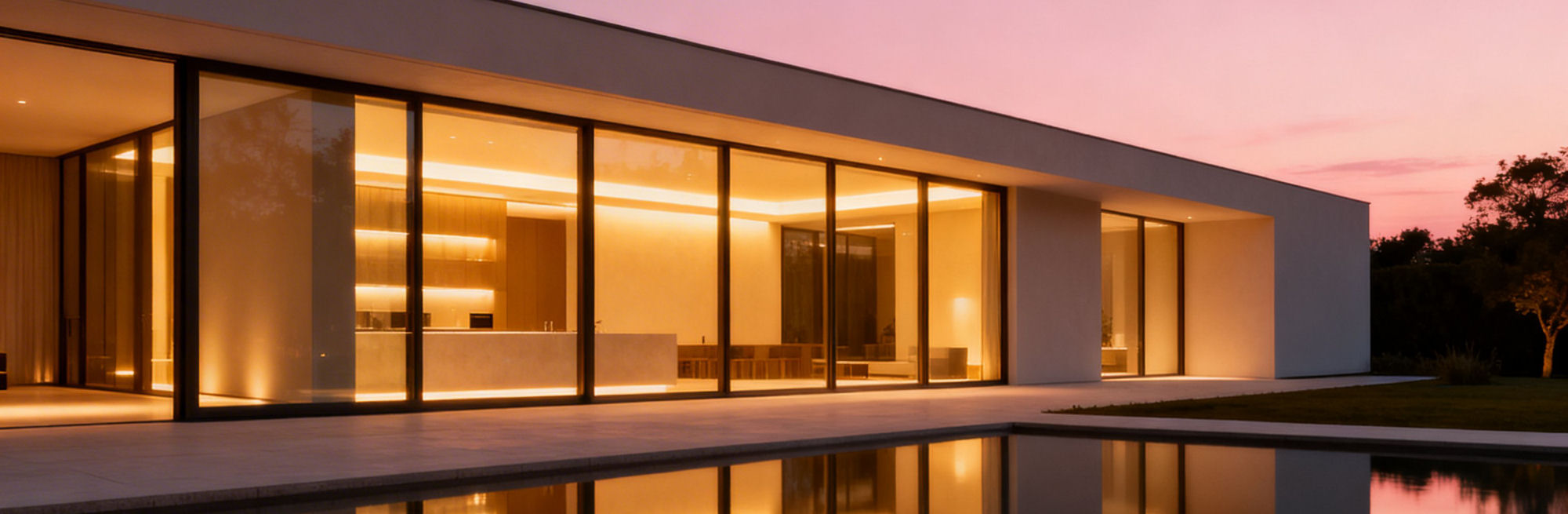
Sliding windows and doors are defined by their space efficiency, clean sightlines, large glass areas, and the ease with which they create a direct, unobstructed connection between interior and exterior spaces. From a narrow bathroom vent window to a floor-to-ceiling sliding glass wall spanning an entire living room, the sliding configuration scales across a wider range of sizes and applications than almost any other window or door type.
Sliding Windows
How They Work
A sliding window consists of two or more panels within a single frame. In the most common two-panel configuration, one panel is fixed and one slides horizontally in front of or behind it. In a three-panel configuration, the center panel is typically fixed with two operable panels that slide toward the center from each side — or one fixed center panel with one operable side panel, depending on the width and ventilation requirements. The operable panel is moved by hand using an integrated handle or pull, and secured in the closed position by a latch or multi-point locking mechanism on the meeting stile.
Ventilation
A sliding window provides ventilation through the portion of the frame occupied by the operable panel when it is open. In a standard two-panel configuration, this is approximately half the total window width — moving the operable panel fully open exposes roughly 50% of the overall frame area to airflow. This is a meaningful ventilation opening for most residential applications, though it is less than the 100% clear opening available from a casement window of the same size.
The ventilation opening of a sliding window is horizontal and low, at sill height — a profile that works well for capturing prevailing breezes at ground level and is less prone to rain infiltration than upward-opening windows in wet weather. In rooms where low-profile ventilation is preferable to a high projecting sash — bathrooms, narrow hallways, stair landings — the sliding window is often the most practical choice.
Where Sliding Windows Work Best
Sliding windows are particularly well suited to locations where an outward-projecting sash would be impractical or hazardous — above outdoor walkways, patios, or decks where a swinging casement would obstruct passage; in tight interior spaces where an inward-opening sash would interfere with furniture or cabinetry; and in wide horizontal openings where a large glass area is desired without a structural mullion dividing the composition. They are also the natural choice for basement-level windows where the exterior grade is close to the window sill and outward-swinging clearance is unavailable.
Airtightness Trade-Off
Sliding windows have a lower inherent airtightness than casement windows. Because the operable panel must slide within the frame rather than compress against a fixed seal, the contact between the sliding sash and the weatherstrip cannot achieve the four-sided compression seal of a hinged window. This means that at equivalent glazing specifications, a sliding window will have a slightly higher air infiltration rate than a casement. The difference is manageable with quality weatherstripping and well-manufactured track systems, and for most residential applications in moderate climates it is not a significant factor. In cold climates or high-performance building applications where air infiltration is a primary concern, casement windows are the stronger choice.
Sliding Glass Doors
How They Work
A sliding glass door — also called a patio door or gliding door — operates on the same principle as a sliding window but at door scale: one or more large glass panels slide horizontally on precision track systems to open or close the doorway. The most common residential configuration is a two-panel unit in which one panel is fixed and one slides; three- and four-panel configurations with multiple operable panels are available for wider openings.
The fixed and operable panels are equal in size and sit in the same plane, meaning the door assembly is flush with — or minimally proud of — the wall surface on both interior and exterior. Nothing projects outward when the door is open. This is the defining spatial advantage of a sliding glass door over a hinged French door or swinging patio door: the full floor area in front of the door on both sides remains usable at all times, regardless of whether the door is open or closed.
Track and Roller System
The performance and longevity of a sliding glass door are largely determined by the quality of the track and roller system. MILLENNIUM® sliding doors run on precision-machined aluminum tracks with stainless steel or nylon roller carriages that support the full weight of the glazed panel on a continuous bearing surface. The result is smooth, effortless operation across the full range of panel sizes, from a standard 6-foot residential patio door to a large custom unit spanning 12 feet or more.
The track system also incorporates a raised sill threshold that channels any water that enters the track area outward through drainage slots, preventing accumulation and the water infiltration risk it creates. Track drainage is an important detail in climates with significant rainfall or where the door faces a direction exposed to driving rain.
Panel Configurations
Two-panel (OX or XO) — One fixed panel, one operable panel. The most common residential configuration. Suitable for openings from approximately 5 feet to 12 feet wide. “O” denotes the operable panel; “X” denotes the fixed panel. An XO configuration opens from the right (facing the door from inside); an OX configuration opens from the left.
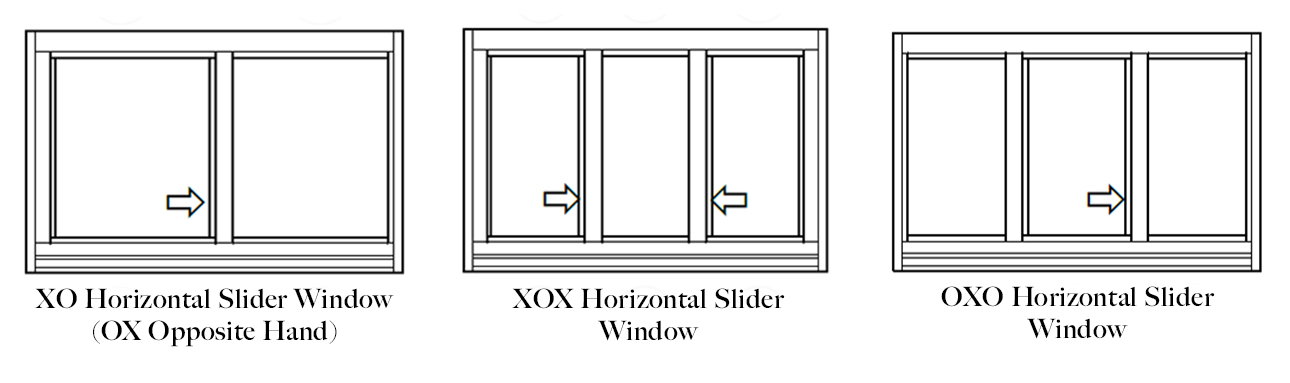
Three-panel (OXO) — A fixed center panel flanked by two independently operable panels that slide toward the center. This configuration provides ventilation from both sides and a particularly wide total opening, making it well suited to larger openings and applications where a connection between interior and exterior is a priority across the full width of the opening.
Three-panel (XXO or OXX) — Two fixed panels and one operable panel, providing a larger fixed glass area and maximum view with ventilation from one side. Appropriate for very wide openings where full operability of all panels is not required.
Four-panel — Two fixed and two operable panels, or all four panels operable with panels stacking behind each other when open. Used in wide architectural openings — typically 12 feet or more — in high-end residential and commercial applications.
The Connection Between Interior and Exterior
The primary design appeal of a sliding glass door is the visual and physical connection it creates between inside and outside. When the operable panel is fully open, the opening is completely unobstructed — no threshold to step over beyond the low sill, no door swing to navigate, just a seamless transition from interior floor to exterior deck, terrace, or garden. This quality makes sliding glass doors the dominant choice for living rooms and dining rooms opening onto outdoor living spaces, for master bedrooms opening onto private terraces, and for any room where blurring the boundary between interior and exterior is an architectural goal.
The large glass area of a sliding door also maximizes natural light and view — a fixed sliding glass panel delivers as much light as any picture window of equivalent size, while the framing profile of a quality aluminum sliding door is slim enough that the glass dominates the composition.
Security
A properly specified sliding window or door provides good security. The multi-point locking mechanism on the meeting stile of a sliding door engages multiple locking points simultaneously when the handle is turned, making forced entry significantly more difficult than a single-point latch. Additional security measures available on MILLENNIUM® sliding doors include:
Anti-lift pins or blocks — Inserted into the upper track to prevent the panel from being lifted out of the track from the exterior, which is a known vulnerability of lower-quality sliding door systems.
Secondary foot bolts or security bars — Surface-mounted bolts at the base of the fixed or operable panel that engage the track floor, providing a secondary mechanical stop that cannot be bypassed even if the primary latch is defeated.
Multi-point locking — Standard on all MILLENNIUM® sliding doors. Multiple locking points along the height of the meeting stile distribute the locking force across the full height of the panel, making forced deflection of the frame significantly more difficult.
Tempered and laminated glass — Tempered glass is standard in sliding door applications as required by code. Laminated glass — available as an upgrade — adds a further security layer because the PVB interlayer holds the glass together even if the pane is shattered, preventing the panel from being used as an entry point even after a breakage attempt.
Energy Performance
Sliding windows and doors are available with the full MILLENNIUM® glazing specification and perform well thermally when properly specified. The key energy performance elements are identical to any other window type: double-pane Low-E insulating glass with argon gas fill delivers meaningful reductions in heat transfer through the glass, warm edge spacer bars minimize thermal bridging at the glass perimeter, and thermally broken frame profiles in the A-Series prevent heat conduction through the aluminum frame itself.
The one energy consideration specific to sliding glass doors is their large glass area. A standard 6-foot sliding glass door has approximately 40 square feet of glazed surface — significantly more than any standard window. This large area makes glazing specification particularly important: the difference in heat loss between a poorly specified and a well-specified sliding glass door unit is larger in absolute terms than the same specification difference in a smaller window, simply because there is more glass area over which the difference accumulates. For south-facing doors in cold climates, passive Low-E coatings that allow solar heat gain are recommended. For west-facing doors in hot climates, solar control Low-E coatings that limit heat gain are the appropriate specification.
Cleaning and Maintenance
Sliding windows and doors require periodic track cleaning to maintain smooth operation and prevent debris from accumulating in the channels. Dirt, grit, and debris in the track act as an abrasive on the roller system and weatherstripping, and can cause the panel to bind or require excessive force to slide. Track cleaning — using a vacuum and a soft cloth or brush — is a simple maintenance task that should be performed at least twice a year, or more frequently in dusty or high-pollen environments.
The rollers themselves are adjustable on all MILLENNIUM® sliding units, allowing the panel height to be fine-tuned to maintain uniform contact with the top guide and bottom track. If a panel begins to feel heavy, stick, or travel unevenly, a roller adjustment — a simple procedure using a Phillips screwdriver through an access port in the frame — will typically restore smooth operation without any parts replacement.
Weatherstripping on the meeting stile and perimeter should be inspected annually. Quality weatherstripping lasts many years under normal conditions but will eventually compress or crack with age and UV exposure, increasing air infiltration. Replacement weatherstripping is available as a service item from MILLENNIUM®.
MILLENNIUM® Frame Series
A-Series — Thermally Broken Aluminum All-aluminum frame with a polyamide thermal break in both the frame and the sliding panel stiles, eliminating thermal bridging through the frame. The dimensional precision and corrosion resistance of aluminum make it the preferred frame material for large sliding door panels, where frame stiffness directly affects track alignment and long-term smooth operation. Available in a full color palette with powder coat finishes rated for long-term exterior exposure. Ideal for contemporary, modern, and commercial architecture.
M-Series — Aluminum Exterior / Wood Interior Aluminum exterior frame surfaces with a natural wood interior. The aluminum exterior handles weather exposure without maintenance while the wood interior provides warmth and design flexibility — paintable or stainable to any interior finish specification. An excellent choice for traditional and transitional homes where the exterior aluminum profile suits the building envelope and the wood interior complements the interior design.
W-Series — Solid Wood / Aluminum Exterior Cladding A solid wood frame protected externally by aluminum cladding. The wood interior provides the richest visual quality and the best natural thermal insulation of any frame material. Appropriate for traditional, craftsman, and period residential architecture where wood authenticity is integral to the design intent.
Glass Specifications
All MILLENNIUM® sliding windows and doors include double-pane Low-E insulating glass with argon gas fill, warm edge spacer bars, and butyl rubber perimeter seals as standard. Tempered glass is standard in all sliding door applications and in any sliding window panel within 18 inches of the finished floor, as required by building code. Laminated glass, ballistic-resistant glazing, and triple-pane configurations are available as upgrades for applications requiring enhanced security, acoustic performance, or maximum thermal insulation.
Contact MILLENNIUM® Windows and Doors for a free consultation and appraisal. We will help you determine the right panel configuration, size, frame series, and glazing specification for your sliding window or door project and handle professional installation from start to finish.
Phone: 918-582-5025