What Is a Tilt and Turn Window?
A tilt and turn window is a single-sash window operated by one handle that provides three distinct functional modes — closed and locked, fully open as an inward-swinging casement, and partially open in a secure top-tilt ventilation position — all within the same frame and sash assembly. Originating in Germany and standard across most of Europe, the tilt and turn is one of the most mechanically sophisticated and functionally versatile window types available in residential and commercial construction.
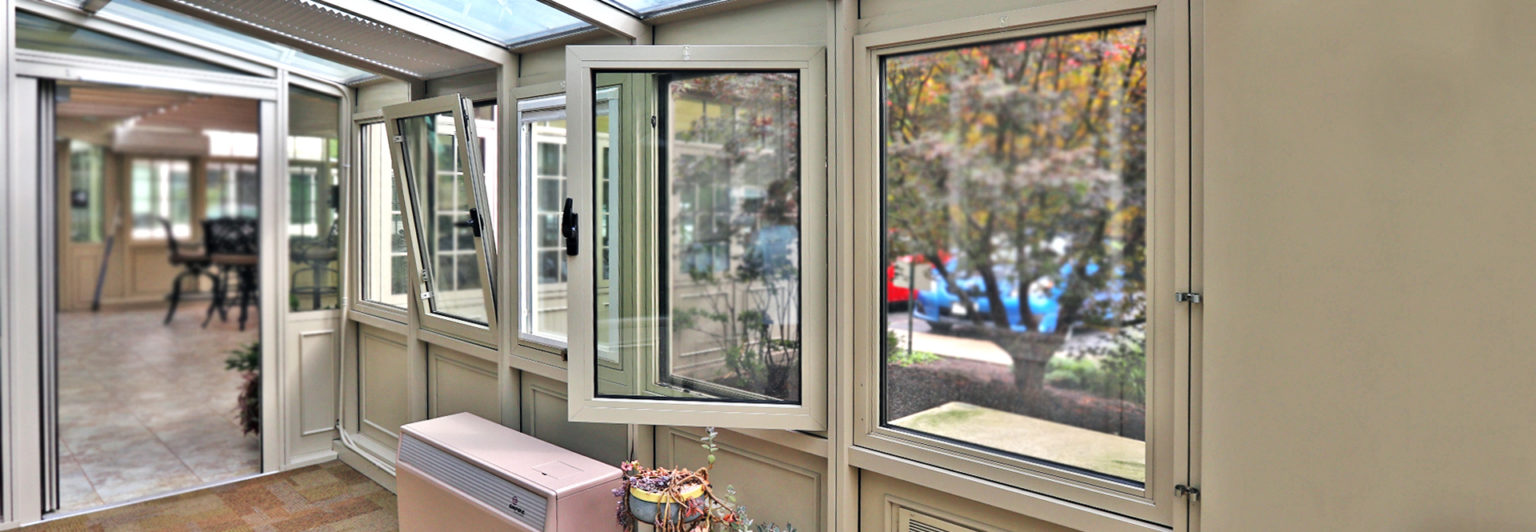
MILLENNIUM® offers tilt and turn windows as part of the A-Series aluminum frame line — thermally broken, custom sized, and available in the full range of glazing specifications. They are also available as full-height door units for balcony and terrace applications where the inward-swing and tilt functions of the window translate directly to door scale.
How It Works: The Three Positions
The entire operation of a tilt and turn window is controlled by a single handle with three positions. The mechanical linkage connecting the handle to the multi-point locking and hinge system is engineered so that each handle position engages a fundamentally different set of hardware functions. This is the core engineering achievement of the tilt and turn: a single intuitive control that selects between three completely different operational states.
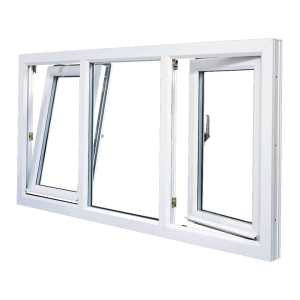
Position 1 — Handle Pointing Down: Closed and Locked When the handle points straight down, the multi-point locking mechanism is fully engaged. Locking points around the full perimeter of the sash — top, bottom, and both sides — are simultaneously driven into their keeps in the frame by a continuous gearbox running around the sash perimeter. The sash is compressed uniformly against the perimeter weatherstrip, creating a four-sided compression seal with no movable joints or operational clearances. This is the tightest closure achievable in any operable window type, providing airtightness performance approaching that of a fixed window.
In this position, the window presents an uninterrupted, unobstructed single pane of glass with no center rail or meeting stile — a clean, frameless view that no double-hung or sliding window can match.
Position 2 — Handle Pointing Horizontal (90°): Full Inward Swing Rotating the handle to the horizontal position disengages the locking points and activates the side hinges, allowing the sash to swing fully inward on its vertical hinge axis — exactly as a casement window would open, but opening inward rather than outward. The sash swings to approximately 90°, providing a full, unobstructed opening equal to the entire sash area.
This position is used when maximum ventilation is required, when the full opening is needed for emergency egress, or when both interior and exterior glass surfaces need to be cleaned. Because the sash swings inward, both faces of the glass are fully accessible from inside the room — no ladders, no exterior access required, even on upper floors. The sash swings parallel to the interior wall when fully open, so its projection into the room is equal to the depth of the sash itself rather than the full width of the opening.
Position 3 — Handle Pointing Up (180°): Top Tilt Ventilation Rotating the handle to the fully upward position engages the bottom hinges and disengages the side locking points, allowing the top of the sash to tilt inward by several inches while the bottom remains anchored. The sash tilts to a fixed angle — typically 10° to 15° from vertical — and is held in this position mechanically by a scissor stay or friction hinge that prevents further opening without deliberate effort.
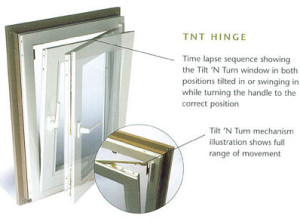
This tilt position is the defining feature of the tilt and turn and the function that makes it genuinely unique among window types. In the tilt position:
Fresh air enters through the gap at the top of the sash and is deflected upward and inward by the tilted glass surface, rising toward the ceiling before descending as it cools — a convective air movement pattern that ventilates the room without creating drafts at occupant level. This is draft-free ventilation, and it is meaningful: a person sitting or sleeping near a tilt and turn window in tilt position will not feel a cold draft even in winter, while the room is still receiving continuous fresh air exchange.
Rain resistance is substantially maintained. Because the opening is at the top of the sash and the sash face is angled slightly inward, precipitation striking the exterior face of the glass runs downward off the sill rather than being scooped into the opening. Light rain does not significantly penetrate a window in tilt position, making it practical to leave the window tilted during moderate weather events without risk of water damage.
The tilt position provides meaningful security. The sash opening in tilt position is a narrow gap at the top — typically 3 to 4 inches — through which no person can pass. The scissor stay or friction hinge preventing further opening is robust enough that forcing the sash open further from outside requires significant effort and would cause audible mechanical damage. A tilt and turn in tilt position can safely be left unattended — including during sleep and during absences from the room — in a way that a fully open casement or hung window cannot.
The Hardware System: How the Engineering Works
The tilt and turn mechanism is a precision-engineered gearbox system that runs continuously around the perimeter of the sash within the sash frame profile. In its simplest description, it is a set of interlocking cams and keeps that, depending on the handle position, either lock all locking points simultaneously, engage the side hinges while releasing the top and bottom locks, or engage the bottom hinges while releasing the side and top locks.
The system requires that the handle be operated in sequence — the sash must be closed before switching between positions, and the positions must be selected in the correct order to avoid placing mechanical stress on the linkage. Specifically: the sash must be fully closed before rotating the handle past horizontal to the vertical (tilt) position. Attempting to rotate to the tilt position while the sash is swung open will engage the bottom hinge mechanism while the sash is in the wrong geometric relationship to the frame, placing stress on the corner connections. This is a known characteristic of the tilt and turn mechanism, not a flaw — it is easily avoided by establishing the habit of closing the sash before switching modes, which takes approximately two seconds and becomes automatic with very brief experience.
The hardware is manufactured to precision tolerances and is designed for very long service lives — quality European tilt and turn hardware is rated for 50,000 to 100,000 operating cycles, equivalent to several daily operations over the entire useful life of the building.
Key Advantages
Three Functions, One Frame The most obvious advantage is the one that defines the product: one window does the work of three. A fixed window, an inward casement, and a secure tilt ventilator are all present in a single sash. This functional density is particularly valuable in situations where wall space is limited, where a single opening must serve multiple purposes, or where the simplicity of a single cleanly designed window unit is preferable to a combination of different window types.
Superior Airtightness In the closed position, the continuous perimeter multi-point locking system compresses the sash against a complete, unbroken perimeter weatherstrip with no operational clearances anywhere around the sash. This four-sided, multi-point compression seal provides airtightness performance that is at least equal to that of a high-quality casement window and superior to any sliding, hung, or sliding window of equivalent size and frame quality. For energy-efficient building design, this airtightness is a primary performance advantage.
Draft-Free Ventilation in Tilt Position The deflection of incoming air upward across the tilted sash face — rather than straight into the room as from a swinging casement or horizontally from a sliding window — creates a room ventilation pattern that provides fresh air exchange without uncomfortable drafts. This is the ventilation mode for everyday use: quiet, weather-tolerant, secure, and thermally comfortable even in cold weather.
Ease of Cleaning When swung fully open in the casement position, both interior and exterior glass surfaces are completely accessible from inside the room. The exterior face of the glass — normally inaccessible on upper floors — rotates inward to face the occupant, requiring only a cloth and cleaning solution without any exterior access, scaffolding, or equipment. On upper floors of multi-story buildings, this is not a convenience feature but a practical necessity, and it is one of the primary reasons tilt and turn windows are the dominant operable window type in European high-rise residential construction.
Unobstructed View In the closed position, the tilt and turn sash presents a single uninterrupted pane of glass with no center rail, meeting stile, or dividing bar of any kind. The frame profile is visible only at the perimeter. In comparison to a double-hung window — which always has a horizontal meeting rail across the center of the view — or a sliding window with its vertical meeting stile, the tilt and turn provides a genuinely superior unobstructed view through the glass.
Balcony and Tight-Space Applications Because the tilt and turn opens inward rather than outward, it requires no exterior clearance — no swing path outside the building that must be kept free of planters, railings, adjacent walls, or foot traffic. This makes it the optimal operable window type for balconies, where outward-swinging casements would project over the railing or require dangerous proximity to a fall edge, and for any installation where exterior clearance is constrained.
Honest Considerations: Where Tilt and Turn Has Trade-Offs
Cost Tilt and turn windows carry a higher unit cost than simpler window types of equivalent size. The precision gearbox hardware, the higher-strength sash profiles required to support the weight of the sash across multiple hinge configurations, and the generally higher manufacturing tolerances required all contribute to this premium. For applications where the full tilt and turn functionality is genuinely needed, the premium is well justified. For applications where a fixed window or simple casement would serve equally well, specifying a tilt and turn may be unnecessary cost.
Frame Profile Depth and Visual Weight The sash and frame profiles of a tilt and turn window are necessarily deeper and heavier than those of a simple fixed window or casement, because they must accommodate the multi-point locking gearbox, multiple hinge types, and the structural requirements of a sash that opens in two perpendicular directions. In applications where maximizing the glass-to-frame ratio and minimizing visual profile depth are priorities — floor-to-ceiling glazing, minimalist contemporary architecture — the heavier profile of a tilt and turn may be aesthetically less suitable than a slim fixed unit or a simple casement.
U.S. Code Considerations for Commercial Applications In most U.S. jurisdictions, commercial building codes restrict window openings with sills below 36 inches above the floor to a maximum opening of a few inches — specifically to prevent falls. In standard commercial applications, the tilt position of a tilt and turn window complies with this restriction because the tilt opening is inherently limited to a few inches. However, the full inward-swing casement position opens the sash completely and may not comply with fall protection requirements in commercial settings without additional guardrails or opening limiters. For residential applications, the full swing position is an excellent egress window when it meets the IRC minimum dimensions — and the sash, when swung fully open, provides an unobstructed clear opening equal to the full sash area.
Sequential Handle Operation Required As noted in the hardware section, the handle must be returned to the closed position before switching between the tilt and swing modes. This is a very minor operational characteristic that becomes automatic within a short time, but it is worth understanding before purchase.
Tilt and Turn Doors
MILLENNIUM® offers the tilt and turn mechanism at door scale as well. A tilt and turn door — typically a full-height glass door panel in an aluminum frame — operates identically to the window: tilt position for ventilation, full inward swing for egress and full opening. This configuration is particularly well suited to balcony doors in apartments and condominiums, where a traditional swinging door would project onto a limited balcony deck area, and to small rear entry doors where the tilt position provides ventilation without the full door being left open.
A tilt and turn balcony door also resolves one of the most common comfort problems in apartments with sliding glass balcony doors: the inability to have gentle ventilation without either sliding the full door open — admitting strong wind and noise — or leaving it cracked, which provides poor security and creates an unstable, rattling condition. The tilt position of a tilt and turn balcony door provides exactly the controlled, rain-tolerant, secure draft-free ventilation that the sliding door cannot.
MILLENNIUM® A-Series Tilt and Turn Specifications
MILLENNIUM® tilt and turn windows are produced in the A-Series thermally broken aluminum frame. The aluminum profiles are extruded to the structural depth required to house the perimeter gearbox hardware and provide the rigidity needed for multi-directional sash operation. The polyamide thermal break separating the interior and exterior aluminum profiles eliminates thermal bridging through the frame, ensuring that the excellent airtightness of the closed tilt and turn sash is matched by equally good thermal resistance through the frame itself.
Glass — Double-pane Low-E insulating glass with argon gas fill, warm edge spacer bars, and butyl rubber perimeter seals as standard. The Low-E coating reduces glass emissivity to as low as 0.02–0.04, limiting heat transfer through the glazing in both directions while maintaining high visible light transmittance. Triple-pane glazing, laminated glass, ballistic-resistant glazing, and acoustic glass specifications are available as upgrades.
Hardware — Precision-machined multi-point locking gearbox with locking points at the top, bottom, and both sides of the sash perimeter. Stainless steel or aluminum alloy hardware components rated for long service life. Scissor stays or friction hinges on the tilt axis calibrated to hold the sash at the correct tilt angle under normal operating conditions including moderate wind pressure on the open sash. Single-action handle with three clearly defined positions.
Sizing — Custom fabricated to any size within the structural limits of the frame and hardware system. Minimum recommended sash width is approximately 16 inches; maximum practical sash width for a single tilt and turn sash is approximately 48 inches, beyond which the weight of the sash and the mechanical demands of the gearbox begin to affect operational smoothness and long-term hardware durability. Wider openings in tilt and turn configuration are achieved with multiple sash units side by side rather than a single oversized sash.
Finishes — Full MILLENNIUM® powder coat color palette for exterior and interior aluminum surfaces. Interior surfaces can be specified in any standard RAL color or in a woodgrain foil finish for compatibility with wood-forward interior aesthetics.
Contact MILLENNIUM® Windows and Doors for a free consultation and appraisal. Our team will walk you through every tilt and turn configuration option, explain how the hardware operates in person, and help you determine whether the tilt and turn is the right solution for each opening in your project.
Phone: 918-582-5025